


Bold and Creative Marketing Strategies: Small Business Edition
Why Most Small Businesses Struggle With Marketing (And How to Fix It)
Creative marketing strategies for small business don’t require a big budget — they require smart thinking and consistent execution.
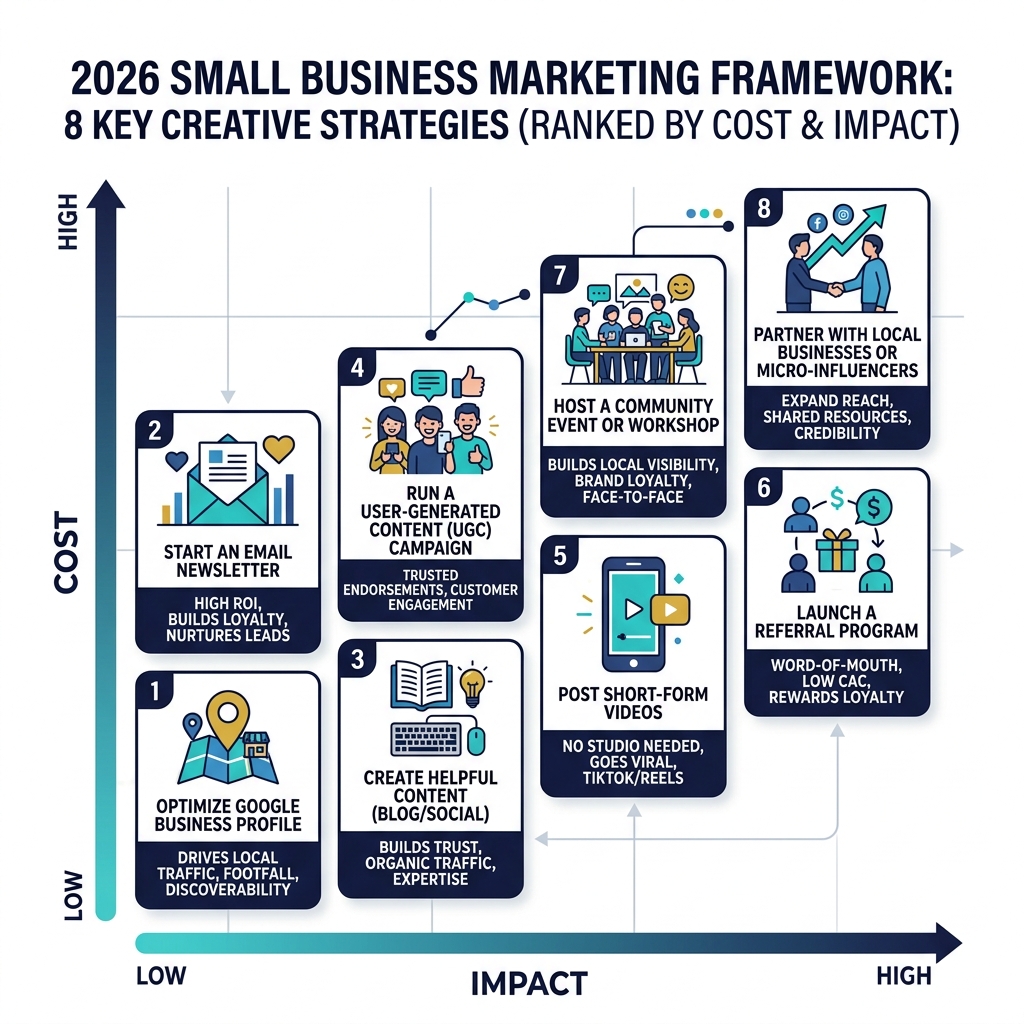
Here are the most effective creative marketing strategies for small businesses right now:
- Optimize your Google Business Profile — free, local, and drives real foot traffic
- Post short-form videos on TikTok, Instagram Reels, or YouTube Shorts — no studio needed
- Start an email newsletter — highest ROI of any marketing channel
- Launch a referral program — word-of-mouth converts better than ads
- Create helpful blog or social content — builds trust and organic search traffic
- Partner with local businesses or micro-influencers — expand reach for free
- Run a user-generated content (UGC) campaign — customers trust other customers
- Host a community event or workshop — builds loyalty and local visibility
Running a small business often means making every dollar — and every hour — count. You can’t afford to guess. The good news? Many of the most effective marketing tactics cost little to nothing. What they do require is clarity, creativity, and focus.
The challenge most small business owners face isn’t a lack of effort. It’s spreading that effort across too many channels without a clear strategy. That leads to inconsistent branding, low engagement, and wasted time.
This guide cuts through the noise. You’ll find bold, proven, and genuinely creative ideas — from guerrilla marketing and community partnerships to short-form video and email automation — all built for businesses working with real-world constraints.
I’m Gianna Heron, founder of Herow Marketing, and my background spans professional performance, Wall Street finance, and creative direction — a combination that gives me a uniquely data-driven yet human approach to creative marketing strategies for small business. I’ve helped businesses across the Lehigh Valley and Tri-State area grow their digital presence with strategies that are both bold and measurable.
Defining Your Creative Marketing Strategies for Small Business
When we talk about creative marketing strategies for small business, we aren’t just talking about “being artsy.” True creativity in marketing is about out-thinking the competition when you can’t outspend them. For a business in Bethlehem, PA, this means finding the intersection between what makes you unique and what your local community actually cares about.

Before you post a single tweet or print a flyer, you must understand the difference between a marketing strategy and a marketing plan. Strategy is your positioning—it’s the “why” and “who.” Execution is the “how”—the actual posts and ads. If your positioning is off, no amount of clever execution will save it. This is why we emphasize branding as the foundation of everything else.
Identifying Your USP to Stand Out
Your Unique Selling Proposition (USP) is the one thing you do better than anyone else. It’s your competitive advantage. Are you a bakery that uses only organic ingredients from a specific farm in the Lehigh Valley? That’s a USP. Are you a web designer who specializes exclusively in e-commerce for local artisans? That’s a USP.
To find yours, ask:
- What is the biggest problem my customers face?
- How do I solve it differently than the “big box” guys?
- Why should someone choose me over a cheaper or closer alternative?
Once you have this, craft your “elevator pitch.” This shouldn’t be a boring job title. Instead of saying “I’m a carpenter,” try “I provide custom woodwork with a 10-year warranty that big retailers can’t match.” This story should be woven into every piece of content you create.
The 3-3-3 Rule for Creative Marketing Strategies for Small Business
One of the biggest mistakes we see small businesses make is trying to be everywhere at once. You don’t need to be on every social media platform. Instead, follow the 3-3-3 rule to keep your resources focused:
- 3 Target Audiences: Define three specific personas (e.g., “The Busy Bethlehem Parent,” “The Local Tech Professional,” “The Weekend Hobbyist”).
- 3 Core Messages: What are the three things they need to know about you? (e.g., Quality, Local Roots, Ease of Use).
- 3 Primary Channels: Pick three places to show up consistently. Maybe it’s Instagram, an email newsletter, and local networking events.
By narrowing your focus, you ensure that your message actually lands rather than getting lost in the noise.
The 5 C’s of Strategic Marketing
To build a “bombproof” strategy, we look at the 5 C’s:
- Company: What are your internal strengths and unique “vibe”?
- Customers: What are their buying triggers and primary problems?
- Competitors: Where are they weak? Can you target the “long-tail” keywords they overlook?
- Collaborators: Who are the non-competing businesses you can partner with?
- Climate: What are the current trends (like the rise of AI or the shift to vertical video) affecting your industry?
High-Impact Digital Tactics on a Zero Budget
Digital marketing doesn’t have to be a money pit. In fact, some of the most effective creative marketing strategies for small business today are completely free—provided you’re willing to put in the time.
Leveraging AI and Automation for Content
Time is your most valuable asset. Using tools like Sprout Social or Buffer allows you to schedule your content in advance, ensuring you stay top-of-mind even when you’re busy running the shop.
We also recommend using AI to scale your efforts without losing your soul. You can use Google Keyword Planner to find what people are searching for, then use AI to help draft outlines for blog posts. A major trend for 2026 is optimizing for AI Overviews (AIO). Google now shows quick AI summaries at the top of search results. To show up there, your content needs to answer common questions concisely and accurately.
Building Authority with Creative Marketing Strategies for Small Business
You are an expert in what you do. Share that expertise!
- LinkedIn: Don’t just post sales pitches. Join professional groups and answer questions. A single helpful reply can get thousands of views.
- Reddit & Quora: Find subreddits related to your industry. If you’re a plumber, help people troubleshoot minor leaks on Reddit. Just remember: help first, sell later.
- Webinars & Podcasts: You don’t need a studio. Use free tools like Audacity to edit audio and host a “hyper-local” podcast interviewing other community figures.
Scaling with Short-Form Video and ASMR
Vertical video is the current “goldmine” for organic reach. Platforms like TikTok and Instagram Reels push your content to people who don’t even follow you yet.
- Behind-the-Scenes: People love seeing how the “sausage is made.”
- ASMR: A handmade candle brand gained 90K followers just by posting “demolding” videos with satisfying sounds.
- Editing: Use CapCut for quick, professional-looking edits on your phone.
| Platform | Best For | Engagement Type |
|---|---|---|
| Visual brands, Retail, Lifestyle | High (Stories/Reels) | |
| TikTok | Creative, Behind-the-scenes, Trends | Explosive (Discovery) |
| B2B, Professional services | Thought Leadership | |
| Local communities, Older demographics | Direct Communication |
Dominating Local Search and Community Presence
For a business in Bethlehem, PA, your neighbors are your best customers. Local search dominates small business discovery, and being visible in your physical community is just as important as being visible online.
The first step is claiming your Google Business Profile. Verified listings receive an average of 1,803 monthly views, and 84% of those come from “discovery” searches (people searching for a service, not a specific brand name). Make sure your profile has at least 10 high-quality photos and that you respond to every single review—even the bad ones.
Don’t stop at Google. Ensure you are listed on Yelp, Bing Places, and other local directories. Only 15% of home service businesses have complete and correct information across these sites—don’t be part of the 85% that’s losing leads to a wrong phone number.
Guerrilla Marketing and Offline Buzz
Guerrilla marketing is about creating an “event” in the real world. It’s unexpected, creative, and often very cheap.
- Chalk Art: A simple, beautiful chalk drawing on the sidewalk leading to your door can stop foot traffic.
- Branded Stickers: High-quality vinyl stickers are “mini billboards.” Give them away at events or include them in packages.
- Community Workshops: Host a DIY night or a free “Intro to Yoga” in a local park. Use Meetup.com to find interested locals.
- Handwritten Notes: In a digital world, a handwritten “Thank You” note included with a purchase has a massive impact on customer loyalty.
When attending local events, remember our top networking dos and don’ts. Focus on building relationships, not just collecting business cards.
Strategic Partnerships and Collaborations
We are big believers in “growing where you’re planted.” Partner with complementary, non-competing businesses. A local coffee shop and a bakery can cross-promote each other’s products. You can even do “content swaps” on social media to reach each other’s audiences.
Joining your local chambers of commerce is another great way to build credibility. Being active in the community—whether by sponsoring a youth sports team or participating in a charity cleanup—improves brand recognition by up to 25%.
Turning Customers into Brand Advocates
It is 5 to 25 times more expensive to acquire a new customer than to keep an existing one. That’s why your current customers are your most powerful marketing tool.
The Power of Email and SMS Marketing
Email marketing is often underrated, but it provides a staggering ROI—roughly $36 for every $1 spent. Unlike social media, you own your email list; you aren’t at the mercy of an algorithm.
- Newsletters: Send one useful email a week. Share tips, stories, or exclusive “VIP” deals.
- Personalization: Use your CRM to segment your list so you’re sending the right message to the right person.
- SMS: With open rates as high as 98%, SMS is perfect for urgent updates or “flash sales.”
If you’re managing your own books and marketing, you can try FreeAgent free to see how integrated tools can save you time.
Gamifying Loyalty and Referrals
Word-of-mouth is “gold dust.” To get more of it, you need to make it fun and rewarding.
- Referral Programs: Give both the referrer and the new customer a discount. Dropbox grew by 3900% in 15 months using this simple strategy.
- Loyalty Perks: Move beyond the basic punch card. Offer tiered rewards, birthday gifts, or “pirate treasure bags” for kids. One toy store found that giving kids “gold coins” to collect for free items created instant repeat customers.
- User-Generated Content (UGC): Encourage customers to post photos of your product with a specific hashtag. People trust recommendations from peers 9.8x more than they trust influencers.
For more advanced strategies on how to turn this traffic into long-term growth, check out our SEO services.
Frequently Asked Questions about Small Business Marketing
How do I measure the ROI of low-cost marketing?
You can’t manage what you don’t measure. Use Google Analytics to track where your website traffic is coming from. If you’re using offline tactics, use unique discount codes or scannable QR codes to see which flyers or events are actually driving sales. Set “SMART” goals (Specific, Measurable, Achievable, Relevant, Time-bound) like “Get 50 new email subscribers this month.”
When should I start planning my marketing strategy?
Ideally, before you even launch your product. Market research and audience validation help you ensure there is actually a demand for what you’re selling. However, if you’re already in business, the best time to start is today. Positioning your brand correctly from the start makes scaling much easier later on.
What are common marketing mistakes small businesses make?
The biggest mistake is spreading resources too thin. It’s better to be amazing on one social platform than mediocre on five. Other common errors include:
- Ignoring Operations: If your customer service is bad, no amount of marketing will help.
- Chasing Vanity Metrics: Likes and followers are great, but “dollars in the bank” is the only metric that keeps the lights on.
- Content Decay: Google loves fresh content. Refresh your old blog posts every 60-90 days to keep them ranking.
Conclusion
At Herow Marketing, we believe that creative marketing strategies for small business are the key to competing with the giants. We provide a time-tested strategic playbook that takes the guesswork out of growth. Based right here in Bethlehem, PA, we pride ourselves on full transparency—you’ll receive monthly data reports so you can see exactly how our efforts are driving measurable results for your business.
Ready to stop shouting into the wind and start being heard? Explore our full range of marketing services and let’s build something bold together.