
Why SEO-Driven Web Development is Your Secret Weapon
Why Most Websites Fail Before Anyone Sees Them
SEO-driven web development is the practice of building websites with search engine visibility baked in from day one — not added as an afterthought after launch.
Here’s what it means in plain terms:
| What It Is | What It Does For You |
|---|---|
| SEO built into the code and structure | Your site ranks faster, from launch |
| Mobile-first, fast-loading design | Google prioritizes your pages |
| Clean site architecture and URLs | Search engines crawl and index every page |
| Structured data and schema markup | Richer search results, higher click rates |
| Content aligned with search intent | You attract buyers, not just visitors |
Most small business websites are built to look good. That’s important. But if search engines can’t crawl your pages, if your site loads slowly on mobile, or if your content isn’t structured the right way — you’re invisible.
And invisible means no traffic. No leads. No sales.
The hard truth? A beautiful website with no SEO foundation is like opening a store with no signage in a back alley. You built something great — but nobody can find it.
That’s exactly what SEO-driven development solves. It combines the technical side of web building with the strategic side of search — so your site works for your business from the moment it goes live.
I’m Gianna Heron, founder of Herow Marketing — and my background spans Wall Street finance, brand creative direction, and digital growth strategy, all of which inform how I approach seo driven web development as a tool for measurable, sustainable business results. In this guide, I’ll walk you through everything you need to know to build — or rebuild — a website that actually ranks.
The Core Pillars of SEO-Driven Web Development
When we talk about the “pillars” of development, we aren’t just talking about picking a pretty font or a cool color palette. We are talking about the skeleton of your site. If the skeleton is crooked, the whole body suffers. In search, if your code is “dirty” or your structure is confusing, Google’s crawlers will simply move on to your competitor.
Crawlability and Indexability
Before a user ever sees your site, a “bot” has to visit it. Search engines like Google use crawlers (often called spiders) to explore the web. If your site has broken links, a messy XML sitemap, or a “robots.txt” file that accidentally blocks important pages, the bots get stuck.
In our Bethlehem, PA office, we often see businesses wondering why their new pages aren’t showing up. Usually, it’s a “crawlability” issue. We ensure every page is reachable and that we’ve provided a clear map (the sitemap) for Google to follow.
Technical SEO for Developers
Technical SEO is where the magic happens. It involves using semantic HTML5 tags. Instead of using generic “div” tags for everything, we use tags like , , and . This tells search engines exactly what each part of the page represents. It’s the difference between giving someone a pile of papers and giving them a neatly organized binder with tabs.
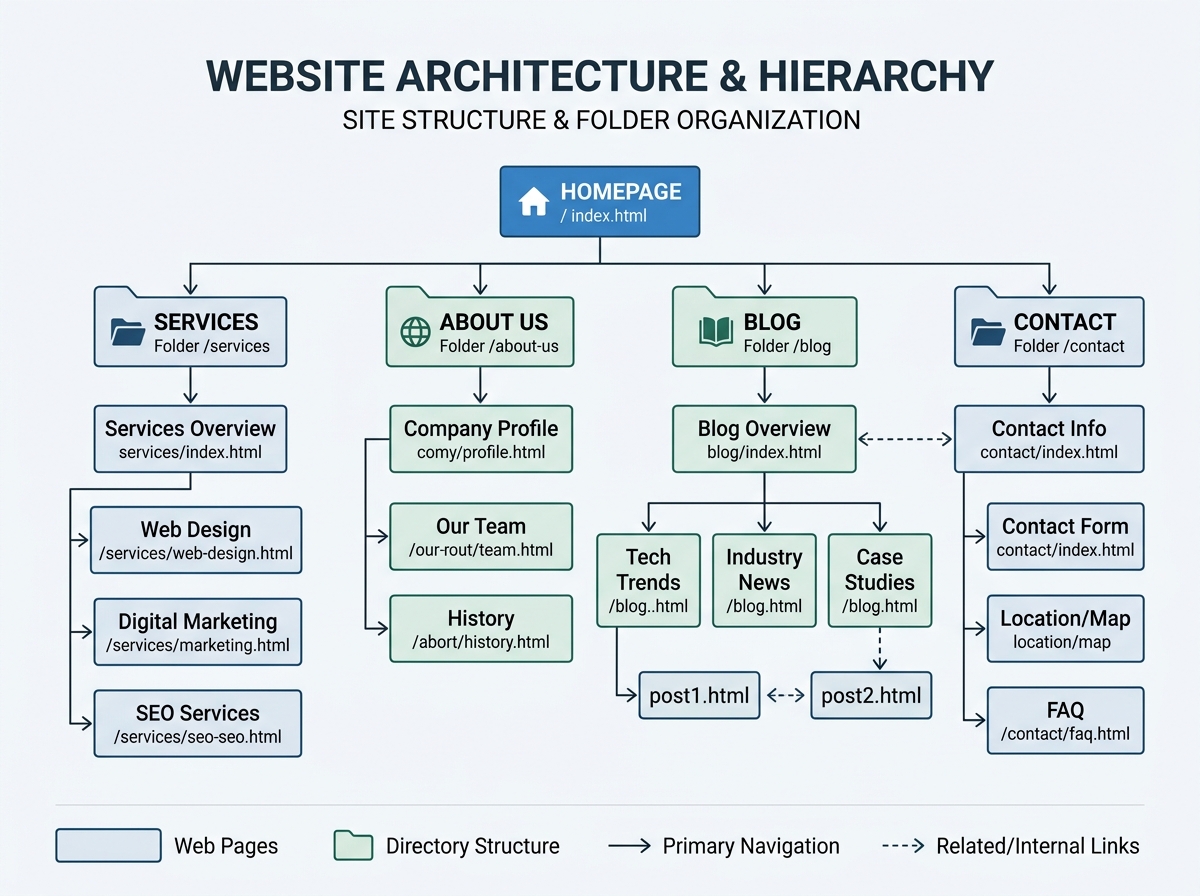
Information Architecture and URL Structure
Your URL structure should be intuitive. Which one looks better to you?
herowmarketing.com/p=12345herowmarketing.com/services/seo-driven-web-development
The second one tells both the user and the search engine exactly what the page is about. We aim for a “flat” architecture, meaning most of your important pages should be no more than three clicks away from the homepage.
Mastering Site Architecture and Siloing
Have you ever walked into a library where the books were just thrown on the floor? You’d never find the mystery novel you were looking for. Site architecture is your digital library system.
Topic Clustering and Siloing We use a method called “siloing” or topic clustering. This means we group related content together. For example, if you are a construction firm, you might have a “Pillar Page” about “Home Remodeling.” Under that pillar, you’ll have smaller, specific articles about “Kitchen Renovation,” “Bathroom Tiles,” and “Basement Finishing.”
All these “cluster” pages link back to the main pillar page. This tells Google: “Hey, we are an authority on Home Remodeling because we have all this detailed information organized in one place.”
Internal Linking Strategy Internal linking is our secret weapon. When we link from a high-traffic blog post to a service page, we are passing “link equity” (or “ranking power”) to that service page. It also keeps users on your site longer, which is a huge signal to Google that your site is valuable.
Implementing Schema Markup for Rich Results
If SEO is a language, Schema Markup (specifically JSON-LD) is the dialect that search engines speak most fluently. It is a piece of code that provides “structured data.”
When you see a search result that shows star ratings, prices, or “Frequently Asked Questions” right there on the Google results page, that is the result of Schema. By implementing this during the development phase, we help your site stand out. You can even test your implementation using the Rich Results Test to see how Google views your data.
This isn’t just about looking fancy; it’s about “entity relationships.” It helps Google understand that “Bethlehem, PA” is a location, “Herow Marketing” is an organization, and “seo driven web development” is a service we provide.
Performance, UX, and Mobile-First Engineering
In 2026, speed isn’t just a luxury — it’s a requirement. Research shows that 42% of people will leave a website because of poor functionality or slow loading times. If your site takes more than three seconds to load, you’ve already lost nearly half of your potential customers.
Choosing the Right Rendering Strategy
How your site “renders” (or loads) matters. Depending on your business goals, we choose between different technical approaches:
| Strategy | Best For… | SEO Impact |
|---|---|---|
| SSR (Server-Side Rendering) | Dynamic sites, E-commerce | Excellent; bots see full content immediately. |
| SSG (Static Site Generation) | Blogs, Portfolios | Best performance; incredibly fast load times. |
| CSR (Client-Side Rendering) | Complex Web Apps | Risky; can lead to “invisible” content for bots. |
Core Web Vitals: The New Gold Standard
Google now uses Core Web Vitals as a direct ranking signal. These metrics measure:
- Largest Contentful Paint (LCP): How fast does the main content load? (Aim for under 2.5 seconds).
- Cumulative Layout Shift (CLS): Does the page “jump around” while loading? (Aim for a score under 0.1).
- Interaction to Next Paint (INP): How quickly does the site respond when you click a button? (Aim for under 200ms).
At Herow Marketing, we treat these as engineering benchmarks. We optimize images, minify code, and use Content Delivery Networks (CDNs) to ensure your site is lightning-fast.
Mobile-First Design in SEO-Driven Web Development
Did you know that mobile devices generated about 58.99% of global website traffic in 2022? Google has noticed. They now use “Mobile-First Indexing,” which means they look at the mobile version of your site first when deciding where to rank you.
If your desktop site is perfect but your mobile site is a mess, your rankings will tank. We design with a “thumb-friendly” UI, ensuring buttons are easy to click and text is readable without zooming. We also optimize the “viewport” so your site looks great on everything from a tiny smartphone to a giant monitor.
Web Accessibility as an SEO Multiplier
Accessibility is often overlooked, but it is a massive opportunity. About 1 billion people around the globe (15% of the world’s population) live with some form of disability that might make it hard to access information online.
By following WCAG 2.0 guidelines, we don’t just do the right thing for people — we do the right thing for SEO.
- Alt Text: Adding descriptions to images helps screen readers and helps Google Images understand your content.
- Transcripts: Providing text for videos helps those with hearing impairments and gives Google more text to index.
- Clean Headers: Logical heading structures help people using screen readers navigate, just as they help search bots.
Content Strategy and E-E-A-T Integration
You’ve probably heard the phrase “Content is King.” But in the era of AI, “Quality Content is King.” Google evaluates content based on E-E-A-T guidelines: Experience, Expertise, Authoritativeness, and Trustworthiness.
Creating User-First Content
We don’t write for bots; we write for humans. This means understanding “search intent.” Are people looking to buy something, or are they just looking for information?
- Informational Intent: “What is seo driven web development?”
- Transactional Intent: “Best SEO web development agency in Bethlehem PA.”
By mapping our keywords to these intents, we create content that actually answers the user’s questions. We also lean into multimedia trends — 89% of consumers have confirmed that they want to see more videos from brands. Integrating video into your development strategy can significantly boost time-on-site and engagement.
Balancing AI Tools with Human Expertise
AI is a tool, not a replacement for a brain. We use AI to handle the “tedious 70%” — things like generating initial outlines, researching long-tail keywords, or checking for basic structural errors.
However, the “valuable 30%” must be human. AI cannot provide real-world experience, original case studies, or the unique brand voice that makes your business stand out. Google is getting very good at detecting “thin” or robotic content. We ensure every piece of content published on your site feels authentic and authoritative.
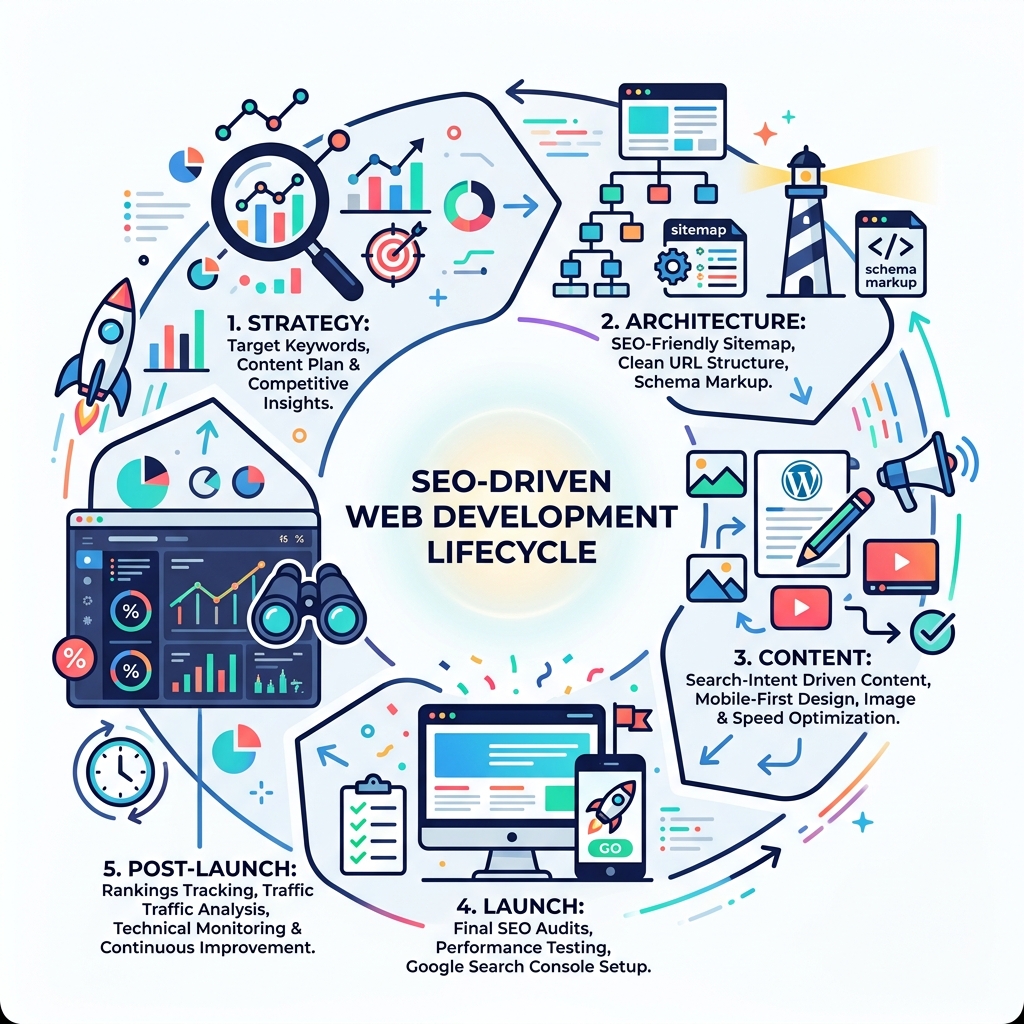
The 4-Stage Roadmap for a Successful Website Launch
Launching a website is like launching a rocket. If you skip a check in the countdown, things go wrong very quickly. We follow a strict 4-stage framework to ensure seo driven web development success.
Stage 1: Strategy and Planning
Before a single line of code is written, we conduct deep keyword research and competitor analysis. We create a “site map mockup” that uses siloing to organize your future content. We ask: “What does success look like for this business?”
Stage 2: The Build Phase
This is where the technical heavy lifting happens. We implement:
- Code Minification: Stripping out unnecessary characters to make files smaller.
- Image Compression: Using WebP or AVIF formats to keep images crisp but lightweight.
- Crawl Control: Setting up your Robots.txt and canonical tags to prevent duplicate content issues.
Stage 3: The Launch
The “Go-Live” moment. We don’t just flip a switch. We set up 301 redirects to ensure that if you had an old site, any existing “SEO juice” is transferred to your new pages. We also connect your site to Google Search Console immediately so we can monitor how Google starts to index your new home.
Stage 4: Promotion and Monitoring
A website is never “finished.” Post-launch, we monitor for errors, track keyword rankings, and analyze user behavior. This is where we integrate with RevOps (Revenue Operations). We don’t just want to see “traffic” go up; we want to see “leads” and “revenue” go up. We provide transparent monthly reports so you can see exactly how your investment is growing.
Conclusion: Your Secret Weapon for Growth
In the digital landscape of 2026, you cannot afford to treat SEO and web development as separate departments. They are two sides of the same coin. A site that is beautiful but unrankable is a waste of money. A site that ranks but provides a terrible user experience is a waste of traffic.
At Herow Marketing, we bridge that gap. Our strategic playbook is built on full transparency and measurable growth. We don’t just build websites; we build high-performance digital platforms designed to dominate search results and convert visitors into loyal customers.
Whether you are based right here in Bethlehem, PA, or looking to grow your brand nationally, our team is ready to help you turn your website into your most powerful sales tool.
Ready to stop being invisible? Explore our SEO and Web Development Services and let’s start building your secret weapon today.
FAQ: Common Questions About SEO-Driven Development
How long does it take to see results from an SEO-optimized build?
While every industry is different, most of our clients see meaningful movement in search rankings within 3 to 6 months. Because we build the SEO foundation during development, you often bypass the “lag time” that traditional sites face when trying to fix SEO issues after the fact.
Is technical SEO more important than content quality?
It’s not a choice between the two — it’s a partnership. Technical SEO ensures Google can find you, while high-quality content ensures Google wants to show you to users. Think of technical SEO as the engine and content as the fuel. You need both to get anywhere.
Why is mobile-first design critical for search rankings?
Since over 60% of organic searches happen on mobile, Google has switched entirely to mobile-first indexing. If your mobile experience is poor, Google assumes your overall site quality is low and will rank you lower, even for desktop searches. Plus, 88% of consumers say they trust user reviews and social proof they can easily find on their phones while on the go. If they can’t find that info easily on your mobile site, you lose the sale.