

Branding Strategies for Startups: Why Your Logo Is Not Your Identity
Why Most Startups Get Branding Completely Wrong
Branding strategies for startups are not about picking a nice logo and calling it a day. They are about building the full experience people have with your business — what they feel, what they remember, and why they choose you over everyone else.
Here is a quick breakdown of the core strategies:
- Define your mission and values — Know why you exist before you design anything.
- Identify your target audience — Speak to a specific group, not everyone.
- Craft your unique value proposition (UVP) — Be clear about what makes you different.
- Develop a consistent brand voice — Use the same tone across every channel.
- Build a visual identity system — Logo, colors, and typography that work together.
- Create a brand style guide — Document your rules so nothing drifts.
- Apply your brand at every touchpoint — Website, emails, social media, packaging.
- Measure and evolve — Track awareness, retention, and referrals over time.
Many founders pour months into building their product, then slap together a logo over a weekend and call it branding. The result? Customers don’t connect. Investors aren’t confident. And the team pulls in different directions.
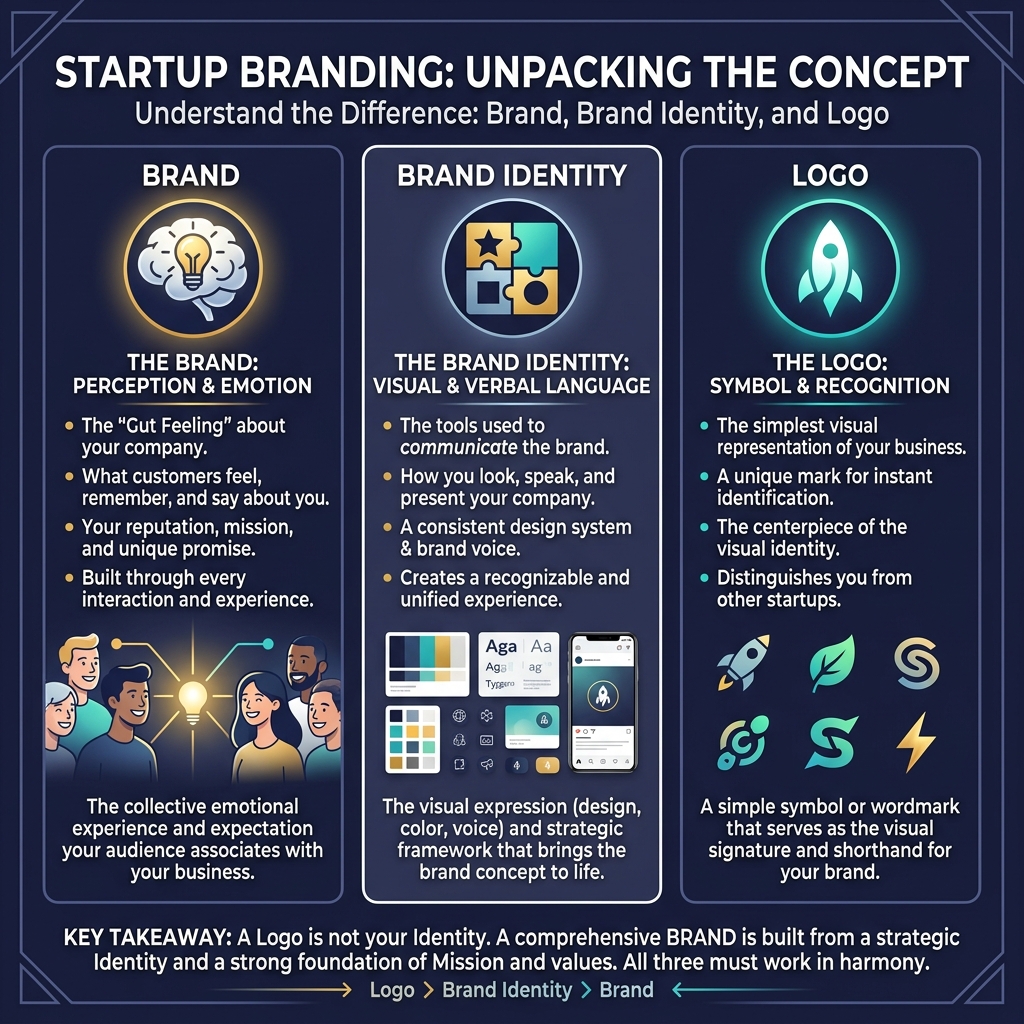
The truth is, your logo is just one small piece of your identity. A brand is the sum of every experience, emotion, and expectation your audience associates with your business. Seth Godin put it well: a brand is “the set of expectations, memories, stories and relationships that account for a consumer’s decision to choose one product or service over another.”
Startups that build a strong brand foundation early grow faster, attract better talent, and close funding rounds with more confidence. Those that treat it as an afterthought spend twice as much fixing it later.
I’m Gianna Heron, founder of Herow Marketing — with a background spanning creative direction, Wall Street finance, and digital strategy, I’ve developed branding strategies for startups that connect artistic vision with measurable business growth. Let’s walk through exactly how to build a brand that works from day one.
The Strategic Foundation of Brand Identity
When we sit down with founders in Bethlehem, PA, the first thing we clarify is that a brand is a lot more than its visual elements. While a logo is a physical mark, a brand is an emotional experience. It is the “gut feeling” a person has about your company.

Brand vs. Marketing
One of the most common points of confusion is the difference between brand strategy and marketing. Think of brand strategy as the “who” and “why” of your business—it defines your core essence, values, and long-term promise. Marketing is the “how” and “where”—the tactical execution (ads, emails, social posts) used to deliver that brand message to the world.
Marketing might get a customer to click, but your brand is what makes them stay. Without a guiding strategy, marketing spend is often wasted because the message lacks a “North Star” to keep it consistent.
| Feature | Brand Strategy (The Foundation) | Marketing Tactics (The Execution) |
|---|---|---|
| Focus | Internal identity and long-term perception | External reach and short-term sales |
| Goal | Build trust and loyalty | Drive traffic and conversions |
| Timeline | Permanent (evolves slowly) | Campaign-based (changes frequently) |
| Output | Mission, Values, UVP, Voice | Ads, SEO, Social Media, Events |
Mission, Values, and the Unique Value Proposition (UVP)
Every successful startup begins with a Value proposition. This isn’t just a list of features; it’s a statement of how you solve a specific problem better than anyone else. As Arielle Jackson explains, the best companies can explain what they do in one simple sentence.
To find your UVP, you must identify what makes you “good and different.” If you are just “good,” you are a commodity. If you are just “different,” you are a novelty. You need both to survive.
The Core Pillars of branding strategies for startups
To build Unforgettable branding, you must anchor your business in four pillars:
- Target Audience: You cannot be everything to everyone. Stripe succeeded because they chose to speak specifically to developers. Define your buyer personas—their pains, gains, and daily “jobs to be done.”
- Brand Voice: How do you sound? Are you the “rebel” challenging the industry, or the “sage” providing wisdom? Your voice should be based on 3-5 core personality traits.
- Narrative: People don’t buy products; they buy stories. Your brand narrative should position the customer as the hero and your startup as the guide helping them overcome a challenge.
- Mission and Values: These shouldn’t be generic posters on a wall. They should be operational filters for how you hire, how you build product, and how you treat customers.
Building Trust Through Visual Consistency
Once the strategy is set, we translate it into a brand identity. This includes your logo, color palette, and typography. The goal here is recognition and differentiation.
Consistency is the secret sauce. Research shows that consistent brand presentation across all platforms increases revenue up to 20%. Why? Because familiarity breeds trust. If your website looks like a professional tech firm but your Instagram looks like a chaotic garage sale, consumers get “brand whiplash.” In fact, 80% of consumers recognize a brand better when it is consistent, and 90% expect that same quality across every channel they use.
A Step-by-Step Process to Build Your Brand from Scratch
Building a brand is a marathon, not a sprint, but the first 30 to 60 days are critical. Here is the workflow we recommend for startups looking to establish a professional presence quickly.
Step 1: Market Research and Competitive Analysis
Before you pick a color, you need to know the landscape. Conduct a SWOT analysis (Strengths, Weaknesses, Opportunities, Threats) and look at your top five competitors. What colors are they using? What is their “hook”? Your goal is to find the “white space” where you can stand out.
Step 2: Naming Your Startup
A name is the first story you tell. According to Paul Graham’s essay on names, names stick, and getting it right early is vital. A great name should be:
- Memorable: Easy to spell and say.
- Scalable: Doesn’t box you into one narrow product category.
- Available: You need the domain and the trademark.
Step 3: Defining Your Unique Value Proposition (UVP)
Your UVP is the intersection of what your customer needs and what you uniquely provide. To increase brand awareness, your messaging must be clear. Avoid “corporate speak.” Instead of saying “We provide synergistic cloud-based optimization,” say “We help small teams manage projects 2x faster.”
Step 4: Crafting the Visual Assets
Now you can start branding in the traditional sense.
- Logo: It should be simple enough to work as a tiny favicon (16px) and bold enough for a billboard.
- Color Palette: Use color psychology. Blue often signals trust in fintech, while Green signals growth.
- Typography: Choose fonts that are legible across all devices.
Step 5: Creating a Brand Style Guide
This is your “Rule Book.” It ensures that whether a freelance designer or your first marketing hire creates a post, it looks like it came from the same company. It should include logo spacing, color codes (HEX/RGB), and “Do’s and Don’ts” for your brand voice.
Embedding Brand into Company Culture
A brand isn’t just for customers; it’s for your team. When your internal culture mirrors your external message, the brand feels authentic. Statistics show that organizations with highly engaged teams see 21% higher profitability.
Internal brand stewardship means every employee knows the “Why” behind the company. When everyone is aligned, you avoid “death by friendly fire”—where different departments accidentally work against the brand’s core mission. This alignment drives long-term growth and makes every business decision, from product features to customer service scripts, much easier to make.
Budgeting and Measuring Brand Success
“How much should we spend?” is the question every founder asks. The answer depends on your stage, but Branding should never be viewed as an expense—it’s a compounding asset.
Budgeting by Stage
- Pre-Seed/Seed: Focus on the “Minimum Viable Brand.” Allocate 5–15% of your budget to a clean identity and clear messaging. You can use lean tools, but don’t skip the strategy.
- Series A: This is where you invest in professional systems. According to the 2026 Venture Branding Report, early-stage companies now allocate an average of 12.5% of their capital to identity systems.
- Series B and Beyond: At this stage, you are protecting equity and scaling. You might spend 10–20% of your marketing budget on brand-building activities to lower your Customer acquisition cost.
Measuring the Success of branding strategies for startups
You can’t manage what you don’t measure. While brand is “intangible,” its effects are visible in your data:
- Direct Traffic: Are people typing your name into the browser?
- Customer Acquisition Cost (CAC): Strong brands have lower CAC because trust reduces friction in the sales funnel.
- Net Promoter Score (NPS): Are customers likely to recommend you? This measures brand loyalty.
- Pricing Power: Millward Brown research shows that strong brands command a 13% price premium over weak ones.
McKinsey research further confirms that companies using data-driven brand approaches see up to 30% efficiency gains in marketing. When everyone knows what the brand stands for, less time is wasted on alignment and more is spent on execution.
Common Pitfalls in branding strategies for startups
Even the best founders stumble. Here are the “Wrong Way” signs to watch out for:
- The “Logo-First” Trap: Designing a logo before you have a strategy is like picking the paint color for a house before you’ve built the foundation.
- Inconsistency: Changing your tone or visuals every month confuses the market. It takes 3 exposures for recognition and 27 to build true trust.
- Ignoring Feedback: Sometimes your customers find uses for your product that aren’t what you originally intended. Listen to them. Your brand should evolve based on real-world usage.
- Over-Complicating the Message: If you can’t explain what you do to a five-year-old, your brand is too complex. As Hubspot points out, it is easy to fall in love with your own idea and skip over the fact that customers might be confused.
- The “Me-Too” Strategy: Copying a successful competitor’s look and feel only ensures you will always be in their shadow. Differentiate or die.
Frequently Asked Questions about Startup Branding
When should a startup hire a professional branding agency?
In the pre-seed stage, a DIY approach with lean tools can work if the founders have a clear vision. However, once you hit the Seed or Series A stage, professional help becomes essential. You are no longer just “launching”; you are “scaling.” An agency brings objectivity, strategic depth, and the technical skill to build a Brand Identity Portfolio that stands up to investor scrutiny.
How does branding affect website conversion rates?
First impressions are formed in just 50 milliseconds. If your website feels “cheap” or “confusing,” users bounce instantly. A strong brand provides trust signals—professional design, clear CTAs, and a cohesive story—that guide a user through the buyer’s journey and remove friction, directly increasing your conversion rates.
Can a startup rebrand after the seed stage?
Yes, and many do. This is often called a pivot. If your market has evolved or your product-market fit has shifted, your old brand may no longer serve you. The key is to do it strategically—audit your existing brand equity first so you don’t throw away the recognition you’ve already built.
Conclusion
At Herow Marketing, we believe that branding strategies for startups should be a competitive advantage, not a chore. Our strategic playbook is designed to help you build a brand that is both “good and different,” backed by full transparency and monthly data reports to ensure your growth is measurable.
Your brand is your most valuable business asset. It is the story that survives even if your product changes. It’s the reason a customer chooses you when the features and prices are identical.
Ready to stop playing with “mood boards” and start building a brand that actually scales? Join us at Herow Marketing to develop your Branding Blueprint. Whether you need to refine your Brand Identity Portfolio or launch a new social-media campaign, we are here to help you become the hero of your industry.
Ready to build a brand that wins? Let’s talk.