


How to Build an Online Store Without Selling Your Kidney
How to Build an Online Store Without Selling Your Kidney
What Does an Ecommerce Website Actually Cost in 2026?
Ecommerce website price ranges vary widely depending on what you need. Here’s a quick snapshot before we dive in:
| Store Type | Typical Build Cost | Monthly Ongoing Cost |
|---|---|---|
| DIY / Starter Store | $500 – $5,000 | $30 – $100 |
| Small Professional Store | $5,000 – $25,000 | $100 – $500 |
| Custom Growth Store | $25,000 – $150,000 | $500 – $2,500+ |
| B2B / Large Catalog | $75,000 – $250,000 | $2,500+ |
| Enterprise / Headless | $250,000 – $500,000+ | Custom |
Building an online store isn’t one purchase. It’s a stack of systems — storefront, checkout, product database, analytics, fulfillment, and marketing — all running together. That’s why getting a straight answer on cost is so hard.
A basic hosted storefront can start at around $29 per month. But a professionally designed, fully integrated ecommerce site often lands between $25,000 and $150,000 to build. Large B2B catalogs, enterprise builds, or ERP-connected stores can push well past $250,000.
And that’s before you factor in what it costs to keep the site running. Ecommerce sites with fewer than 1,000 products typically cost $15,000 to $30,000 per year to maintain after launch.
The number that matters most isn’t the lowest quote you can find. It’s the right investment for where your business is going.
I’m Gianna Heron — my background spans Wall Street financing, creative direction, and digital marketing, giving me a grounded, strategic lens on what drives real ROI, including how ecommerce website price decisions can make or break a small business’s growth trajectory. That’s exactly what this guide is built around.
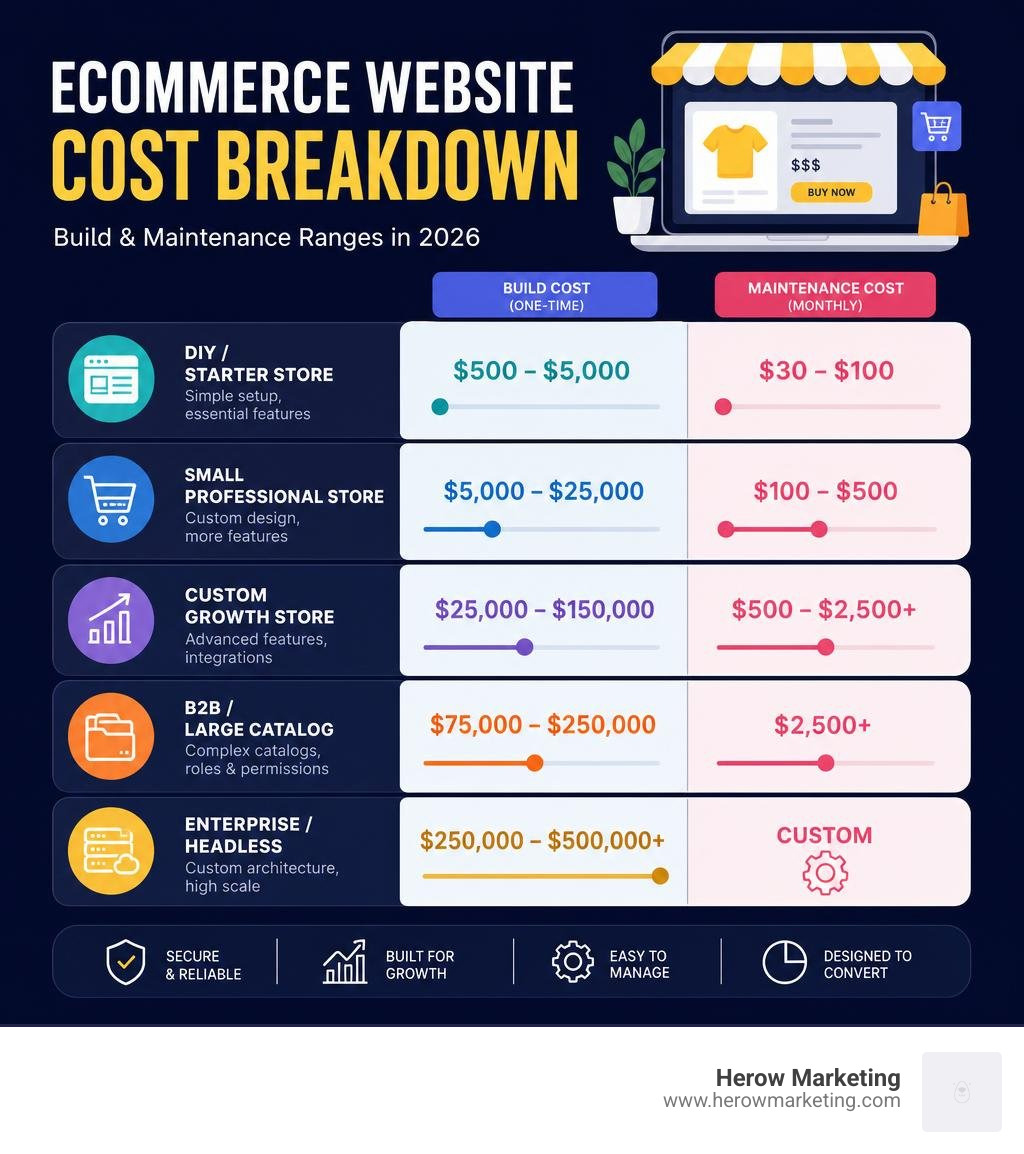
Typical Cost Ranges for Online Stores in 2026
When we sit down with businesses in Bethlehem, PA, and across the Lehigh Valley, the first question is almost always: “What is the average ecommerce website price for a business like mine?”
To give you an honest answer, we have to look at the scale of your operations. A flat “one-size-fits-all” price tag is a myth. Instead, ecommerce development in 2026 falls into distinct tiers based on design complexity, catalog size, and functional requirements.

The Starter Store ($500 – $5,000)
This tier is ideal for solopreneurs, local makers, and startups testing the waters. Usually built on user-friendly hosted platforms like Shopify, Wix, or Squarespace, these sites rely on pre-designed templates. While you save heavily on upfront design and development costs, you will spend your own sweat equity configuring the settings, loading product descriptions, and setting up payment processors.
The Small Professional Store ($5,000 – $25,000)
For established retail businesses transitioning online or growing brands with up to 1,000 products, this is the sweet spot. At this level, you are typically hiring a professional web designer or small agency to customize a premium theme, configure proper taxonomy (how products are categorized), set up essential security protocols, and integrate marketing tools. According to industry data, websites with 1,000 products or less average between $5,000 and $55,000 to build, making this a highly realistic starting point for a professional rollout.
The Custom Growth Store ($25,000 – $150,000)
When your online store is your primary revenue engine, off-the-shelf templates no longer cut it. A custom growth store features tailored user journeys, advanced product filtering, custom checkout flows, and specialized integrations (such as inventory syncs with physical POS systems). This tier is built to scale, handle high traffic volumes, and convert visitors at a much higher rate. For a deeper look at how these platforms scale, you can explore BigCommerce’s 2026 cost breakdown to understand the architectural investments required for mid-market growth.
The B2B and Large Catalog Store ($75,000 – $250,000)
B2B ecommerce is a different beast entirely. It requires complex features like customer-specific pricing tiers, bulk ordering grids, credit limit management, tax-exempt validation, and multi-warehouse inventory tracking. These builds require deep integration with Enterprise Resource Planning (ERP) systems and customer relationship management (CRM) software to automate manual billing and fulfillment workflows.
The Enterprise & Headless Commerce Store ($250,000 – $500,000+)
At the enterprise level, performance, security, and global reach are paramount. Many enterprise brands in 2026 leverage “headless” architecture—decoupling the front-end presentation layer from the back-end commerce engine. This allows for near-instant page load times and completely custom shopping experiences across multiple devices. However, maintaining such an ecosystem requires a dedicated development team and a significant continuous budget.
The Real Factors That Drive Your Ecommerce Website Price
Why does one online store cost $5,000 while another costs $50,000? It comes down to the hidden machinery operating beneath the surface. When budgeting, it helps to understand the specific cost drivers that developers calculate when scoping your project.

- Catalog Size and Complexity: It takes significantly more labor to build, organize, and optimize a 10,000-SKU catalog with multiple variants (size, color, material) than it does to set up a site with 15 single-variant products. Each product page requires optimized images, structured data, and clear taxonomy.
- Design and User Experience (UX): It takes only 50 milliseconds for a user to form a first impression of your website. If you use a basic, unmodified template, your store will look like a hundred others. Custom design involves wireframing unique user journeys, conducting conversion rate optimization (CRO) audits, and building responsive interfaces that prioritize the 75%+ of ecommerce traffic that now occurs on mobile devices.
- SEO and Search Engine Readiness: Building a beautiful store is useless if nobody can find it. Incorporating search engine optimization into the initial development phase—rather than trying to patch it in after launch—is critical. If you want to understand why this matters, read about Why SEO Driven Web Development is Your Secret Weapon to see how structural decisions made during the design phase impact your long-term organic revenue.
- Payment Gateways and Transaction Fees: Processing payments isn’t free. Standard processing rates (like Stripe or PayPal) hover around 2.9% + $0.30 per transaction. At scale, these transaction fees can easily dwarf your monthly platform subscription costs. Choosing a platform that allows you to optimize these gateway connections can save your business thousands of dollars annually.
Platform Subscriptions and Their Impact on Your Ecommerce Website Price
Your choice of platform dictates your long-term cost model. There are two primary paths: Hosted Software-as-a-Service (SaaS) and Self-Hosted Open-Source platforms.
Hosted SaaS platforms like Shopify and BigCommerce bundle hosting, security, SSL certificates, and core checkout functionality into a predictable monthly fee. For example, Shopify’s standard plans range from the Basic plan at $39/month to the Advanced plan at $399/month, while their enterprise tier, Shopify Plus, starts at $2,300/month. You can review Shopify’s 2026 pricing guide for a granular breakdown of their plans, transaction fees, and native features.
On the other hand, open-source solutions like WordPress with WooCommerce are technically free to download, but they are far from “free” to run. You must pay for secure managed hosting (ranging from $25 to $350+/month), purchase your own SSL certificates, pay for premium plugins to add basic marketing and checkout features, and regularly pay a developer to handle core updates so your site doesn’t break or get hacked.
How Custom Features and Integrations Affect Your Ecommerce Website Price
The moment your ecommerce store needs to “talk” to other software, the development price increases. Standard integrations with popular email platforms (like Klaviyo) or basic shipping tools (like ShipStation) are usually quick to configure.
However, custom API integrations—such as linking your store to an legacy ERP system, setting up automated multi-channel price scraping via tools like the Apify Price Scraper, or building a rules-based dynamic pricing engine using tools like PryceScan or Benchra Pricing—require custom backend development.
Even standard platform configurations require expert setup. For instance, managing complex B2B pricing structures, tax exemptions, and localized display rules requires precise backend logic. To see how deeply integrated platforms handle these nuances, look at Odoo’s price management documentation, which highlights the extensive logic required behind the scenes for advanced pricing structures, multi-currency display, and automated tax calculations.
Ongoing and Recurring Costs After Launch
Many business owners blow their entire budget on the initial build, leaving nothing to actually run and market the store. Launching your website is just the beginning of your financial commitment. To avoid unpleasant surprises, your annual budget should account for these ongoing operational costs:
- Domain Registration: Usually a minor expense, running about $10 to $20 per year.
- Web Hosting & Performance Monitoring: If you are on an open-source platform, you will need high-performance hosting to prevent site crashes during peak shopping holidays. This can cost anywhere from $300 to $4,000+ per year.
- Security and Compliance: Maintaining PCI-DSS compliance, purchasing dedicated SSL certificates, and running malware scans are non-negotiable for protecting customer credit card data.
- App and Plugin Subscriptions: Most modern stores rely on third-party apps for product reviews, loyalty programs, size charts, and advanced search filtering. These monthly subscriptions can easily accumulate to $100–$500+ per month.
- Marketing and Customer Acquisition: An empty store on the internet gets zero foot traffic. Email marketing software, pay-per-click (PPC) advertising, social media management, and ongoing search engine optimization are necessary to drive consistent sales. Email marketing alone remains highly lucrative, boasting an average return of $42 for every $1 spent when executed correctly.
To ensure your ongoing marketing budget isn’t wasted on a structurally flawed site, proper technical integration is key. Read about Web Development SEO Integration Stop Playing Hide and Seek with Rankings to see how continuous search engine visibility is maintained through clean code updates and technical site health checks.
Choosing the Right Development Partner
Who builds your website is just as important as the platform you choose. The partner you select directly impacts your project’s timeline, total cost, and overall risk.
- The DIY Route (Low Cost, High Risk): Building the store yourself using basic templates is highly affordable upfront. However, the learning curve is steep. If you configure tax settings incorrectly, break your checkout flow, or fail to secure customer data, it can cost you far more in lost sales and legal headaches than you saved on development fees.
- Freelancers (Medium Cost, Medium Risk): Hiring a freelance developer can be a cost-effective compromise. However, freelancers are often specialists in one area—they might be great at coding but weak on UX design, or brilliant at graphic design but clueless about search engine optimization and backend systems.
- Professional Agencies (Higher Cost, Low Risk): Partnering with an established agency gives you access to a complete team of specialists: UX/UI designers, seasoned developers, copywriters, SEO experts, and project managers. An agency ensures that all the pieces of your ecommerce puzzle—from site speed to checkout conversion—work together seamlessly.
If you are operating in the B2B space, choosing a partner with specialized commercial experience is even more critical. You can learn more by reading our guide on how to Stop Losing Sales with a Better B2B Ecommerce Development Agency to understand how professional development prevents leaky checkouts and lost wholesale accounts.
Frequently Asked Questions about Ecommerce Costs
Is WordPress cheaper than Shopify for ecommerce?
In the short term, WordPress (via WooCommerce) can be cheaper because there are no mandatory monthly platform subscription fees. However, when you factor in the cost of high-quality managed hosting, premium security plugins, paid extension renewals, and the developer hours required to manually run updates and fix conflicts, the long-term cost of ownership is often highly comparable to Shopify. Shopify offers a more predictable monthly cost, while WordPress offers total platform ownership and no revenue-based transaction penalties.
What are the hidden costs of running an online store?
The most common hidden costs include:
- Payment processing fees: The standard 2.9% + $0.30 per transaction that processors charge.
- App stack bloat: Monthly fees for marketing, shipping, and loyalty apps that quickly add up.
- Fulfillment and returns: Shipping materials, carrier fees, and the labor required to process customer returns.
- Data migration: The cost of transferring customer accounts, order history, and product data from an old platform to a new one.
How can I reduce the cost of building an ecommerce website?
To keep your initial development costs manageable, we recommend launching with a Minimum Viable Product (MVP). Start with a premium, pre-built theme rather than a 100% custom-coded layout. Limit your initial launch to your core product catalog, and utilize built-in platform features before purchasing third-party app subscriptions. As your store begins generating revenue, you can reinvest those profits into custom design, advanced features, and complex integrations.
Conclusion
At the end of the day, your ecommerce website price shouldn’t be viewed as a sunk expense—it is an investment in your business’s digital storefront. A cheap website that loads slowly, frustrates customers, and fails to rank on Google will ultimately cost you far more in lost revenue than a professionally built, high-converting store.
At Herow Marketing, we help businesses navigate this landscape without the guesswork. Based in Bethlehem, PA, we are a digital marketing agency specializing in branding, web development, SEO, and media production. Our unique selling proposition is a time-tested strategic playbook combined with absolute transparency. We don’t hide behind confusing jargon; we provide clear, monthly data reports that show exactly how your investment is driving measurable growth.
Ready to build an online store that actually grows your business? Explore our professional web development services and schedule a consultation with our team today. Let’s build something great together.