

The Complete Guide to Small Business Marketing
Why Small Business Marketing Is the Engine Behind Your Growth
Small business marketing is the process of promoting your products or services to attract new customers and keep existing ones coming back. Done right, it drives consistent leads, builds brand recognition, and creates sustainable revenue growth.
Here’s a quick snapshot of what effective small business marketing involves:
| What It Covers | Why It Matters |
|---|---|
| Defining your target audience | So your message reaches the right people |
| Choosing marketing channels | Focus your budget where it actually works |
| Building brand awareness | Stay top-of-mind before customers are ready to buy |
| Measuring results | Know what’s working and cut what isn’t |
| Using digital and traditional tactics | Reach customers across multiple touchpoints |
The challenge? Most small business owners are already stretched thin. Marketing gets pushed aside, done inconsistently, or done without a real strategy. And when there’s no plan, budgets get wasted and results are hard to measure.
The good news: you don’t need a massive budget to compete. You need smart, focused strategies that match your audience and your goals.
I’m Gianna Heron — founder of Herow Marketing, with a background spanning Wall Street finance, creative direction, and brand strategy — all experience I now channel into helping small businesses build small business marketing systems that actually grow revenue. In this guide, I’ll walk you through exactly what works, what doesn’t, and how to build a strategy that fits your business.
What is Small Business Marketing and Why It Matters
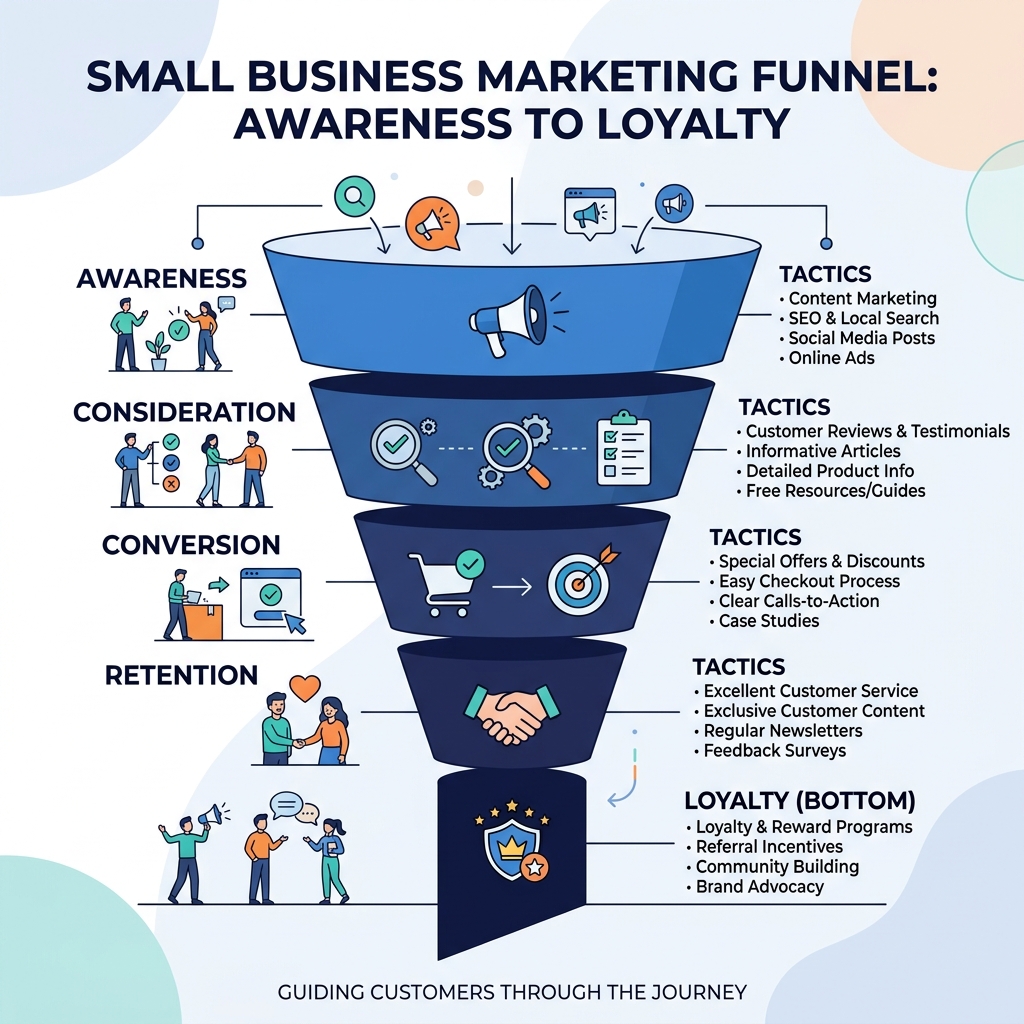
At its core, small business marketing is the strategic promotion of your products or services to attract new customers and retain the ones you already have. It is the bridge between having a great product and actually getting people to pay for it. For a local business in Bethlehem, PA, this means being the first name that pops into a neighbor’s head when they need your specific expertise.
To understand how to position yourself, we often look at the Four Ps method: Product, Price, Place, and Promotion.
- Product: What problem are you solving?
- Price: How does your cost reflect your value and stay competitive?
- Place: Where are your customers looking for you (online or a physical storefront)?
- Promotion: How are you telling your story?
Why does this matter so much? Because 66% of customers expect companies to understand their unique needs. If you aren’t marketing, you aren’t communicating that you understand them. Effective marketing builds brand loyalty and drives revenue growth by ensuring you aren’t just a “one-hit wonder” but a staple in your community.
Building Your Small Business Marketing Plan
We’ve seen it time and again: businesses that wing it often waste it. Research shows that businesses with a structured plan are 6.7 times more likely to report success than those without one. A solid plan keeps you on schedule and, more importantly, on budget.
Step 1: Market Research and Competitive Analysis
Before spending a dime, you need to understand the landscape. This involves market research and competitive analysis to identify gaps in the market. What are your competitors in the Lehigh Valley doing well? Where are they failing? Use these insights to update your business plan and find underserved customers.
Step 2: Define SMART Goals
Your goals should be Specific, Measurable, Achievable, Relevant, and Time-bound. Instead of saying “I want more customers,” try “I want to acquire 20 new monthly subscribers via email marketing by the end of Q3.”
Step 3: Budget Allocation
How much should you spend? While it varies, B2C service companies often spend around 11.8% of their revenue on marketing.
Step 4: ROI Measurement
Marketing is an investment, not an expense. You must track your Return on Investment (ROI) to see which tactics are actually moving the needle. Whether it’s a digital ad or a flyer in a local coffee shop, ask customers how they heard about you and use analytics to track every click.
Essential Digital Marketing Channels
In 2025 and beyond, your digital presence is often your first impression. With over 70% of the world’s population having mobile internet access, your “digital storefront” is always open.
Content Marketing and Email
Content isn’t just about blogging; it’s about providing value. Educational content establishes you as an authority. Once you provide value, you can invite them to join your email list. Email remains the number one preferred channel for communicating with companies.
The real secret sauce? Automation. Research shows that automated workflows generate 30x higher returns compared to one-off email campaigns. It allows you to nurture leads while you sleep.
Social Media
Social media is a powerhouse for spontaneous growth. In fact, 81% of consumers are swayed by social media to make spontaneous purchases. For small businesses, the key is not to spread yourself thin. Pick one or two platforms where your audience actually hangs out—Facebook for the 35+ crowd or Instagram for visual-heavy businesses—and master them.
The Role of SEO in Small Business Marketing
If you aren’t on the first page of Google, you’re practically invisible. Ranking first earns approximately 29% of all clicks. This is where small business marketing gets highly local.
Since 46% of all Google searches have local intent, you must optimize for “near me” searches. This starts with claiming and optimizing your Google Business Profile. Ensure your hours, address, and photos are up to date. Encourage reviews, as nearly 95% of people read them before buying.
Leveraging AI for Small Business Marketing
You don’t need a team of ten to market like a pro anymore. About 98% of small businesses now use some form of AI-enabled software. AI can help with:
- Content Creation: Drafting social posts or email subject lines.
- Customer Service: Using chatbots to answer FAQs 24/7.
- Data Analysis: Identifying patterns in customer behavior to personalize their experience.
However, we always recommend a “human-in-the-loop” approach. AI handles the logistics, but your unique brand voice provides the authenticity that builds trust.
Low-Cost and Traditional Strategies
Digital is dominant, but traditional methods still hold incredible weight, especially in tight-knit communities like Bethlehem.
The Power of Direct Mail
Believe it or not, physical mail is making a comeback. Direct mail can achieve a response rate of 9% to a house list, which is significantly higher than email’s 1% average. A well-designed postcard can cut through the digital noise.
Word-of-Mouth and Referral Programs
Word-of-mouth is the original “viral” marketing. Today, it takes the form of User-Generated Content (UGC). A staggering 87% of consumers believe UGC influences their buying decisions. Encourage your happy customers to tag you in photos or leave a video testimonial.
You can also incentivize this through referral programs. Offering a discount to both the referrer and the new customer is a win-win that lowers your customer acquisition cost.
Networking and Partnerships
Don’t underestimate the power of a handshake. Partnering with complementary local businesses—like a coffee shop cross-promoting with a local bakery—allows you to tap into an existing, loyal audience for free.
Overcoming Challenges and Future Trends
The biggest challenge for small business marketing is usually time and budget. Many owners feel they have to choose between doing the work and finding the work.
In-House vs. Agency
About 37% of small businesses outsource at least one business process. While handling marketing in-house gives you total control, hiring an agency like us can actually save money by preventing costly trial-and-error mistakes. We provide full transparency via monthly data reports, so you always know exactly where your investment is going.
2025 Trends to Watch
- Video Marketing: Short-form video (Reels, TikTok) is no longer optional. It’s the fastest way to build familiarity.
- Personalization: 80% of consumers want a personalized shopping experience. Use your CRM data to send birthday discounts or product recommendations based on past buys.
- Voice Search: As more people use Alexa and Siri, your SEO needs to account for how people speak, not just how they type.
Frequently Asked Questions about Small Business Marketing
Who is your target market and how do you identify them?
Your target market is the specific group of people most likely to buy your product. You identify them by creating “customer personas.” Look at your current best customers: How old are they? What are their pain points? What do they value? If you try to market to everyone, you end up marketing to no one.
How much should a small business spend on marketing?
A general rule of thumb is 2% to 5% of your revenue for maintenance, and 10% to 15% if you are in a high-growth phase. However, for those just starting, we recommend focusing on high-impact, low-cost activities like SEO and email list building first.
What payment methods should I accept?
To ensure you don’t lose a sale at the finish line, accept as many forms as possible: credit cards (using EMV chip readers for security), online payments, and even mobile wallets. Just remember the IRS requires you to report cash payments over $10,000 from a single buyer.
Conclusion
Marketing your small business doesn’t have to be a mystery. By combining a solid plan, the right digital tools, and a touch of local community engagement, you can build a brand that stands the test of time.
At Herow Marketing, we believe in a strategic playbook backed by data. We don’t just post for the sake of posting; we drive measurable growth through branding, SEO, and media production. If you’re ready to stop guessing and start growing, we’re here to help.