
Why Your Business Needs Professional CMS Development Services Today
Why Your Business Needs Professional CMS Development Services Today
Why CMS Development Services Are Now a Business Essential
CMS development services give businesses a professional, custom-built system to create, manage, and publish website content — without needing a developer every time you want to make a change.
If you’re trying to figure out what they actually include, here’s the short version:
| What You Get | What It Means for You |
|---|---|
| Custom CMS build | A system built around your workflow, not a generic template |
| Content migration | Move your existing content without losing SEO rankings |
| Third-party integrations | Connect your CRM, email tools, and payment systems |
| Editor experience design | Your team can publish content easily, without breaking things |
| Ongoing support & security | Regular updates, backups, and compliance monitoring |
WordPress powers over 43% of all websites globally — yet many businesses still struggle to publish content consistently, maintain their site, or scale without it becoming a technical nightmare. The problem usually isn’t the platform. It’s that the platform was never properly built for the business using it.
One insight that keeps coming up across the industry says it well: a site is launched once, but a CMS is used every single day. That gap — between a pretty launch and a system your team actually uses — is exactly where professional CMS development makes the difference.
I’m Gianna Heron, founder of Herow Marketing, and my background in brand strategy, creative direction, and business growth gives me a unique lens on CMS development services — because the best content systems aren’t just technical builds, they’re strategic tools that drive measurable results. In this guide, I’ll walk you through everything you need to know to make the right decision for your business.
Explore more about cms development services:
Understanding the Scope of Modern CMS Development Services
When we talk about modern cms development services, we are looking at something far more comprehensive than simply installing a theme on a server and handing over the login credentials. True CMS development is about creating a custom digital architecture. It involves designing a highly tailored workspace that perfectly matches your organization’s unique operational needs, publishing workflows, and growth targets.
A modern content platform is built like software, not configured like a weekend hobby. It requires meticulous content modeling, clear system planning, and a strong focus on long-term maintainability. When done right, it serves as the central operating system for your business’s public-facing digital presence. If you’ve ever read An Honest Review of Web Development Agency, you already know that the difference between standard and exceptional agencies often lies in how they handle these complex, structural back-end configurations.
Experienced developers emphasize that a business should never have to bend its operations to fit the rigid limitations of a software platform. Instead, the platform must be developed to serve the business.
Core Components of Custom CMS Architecture
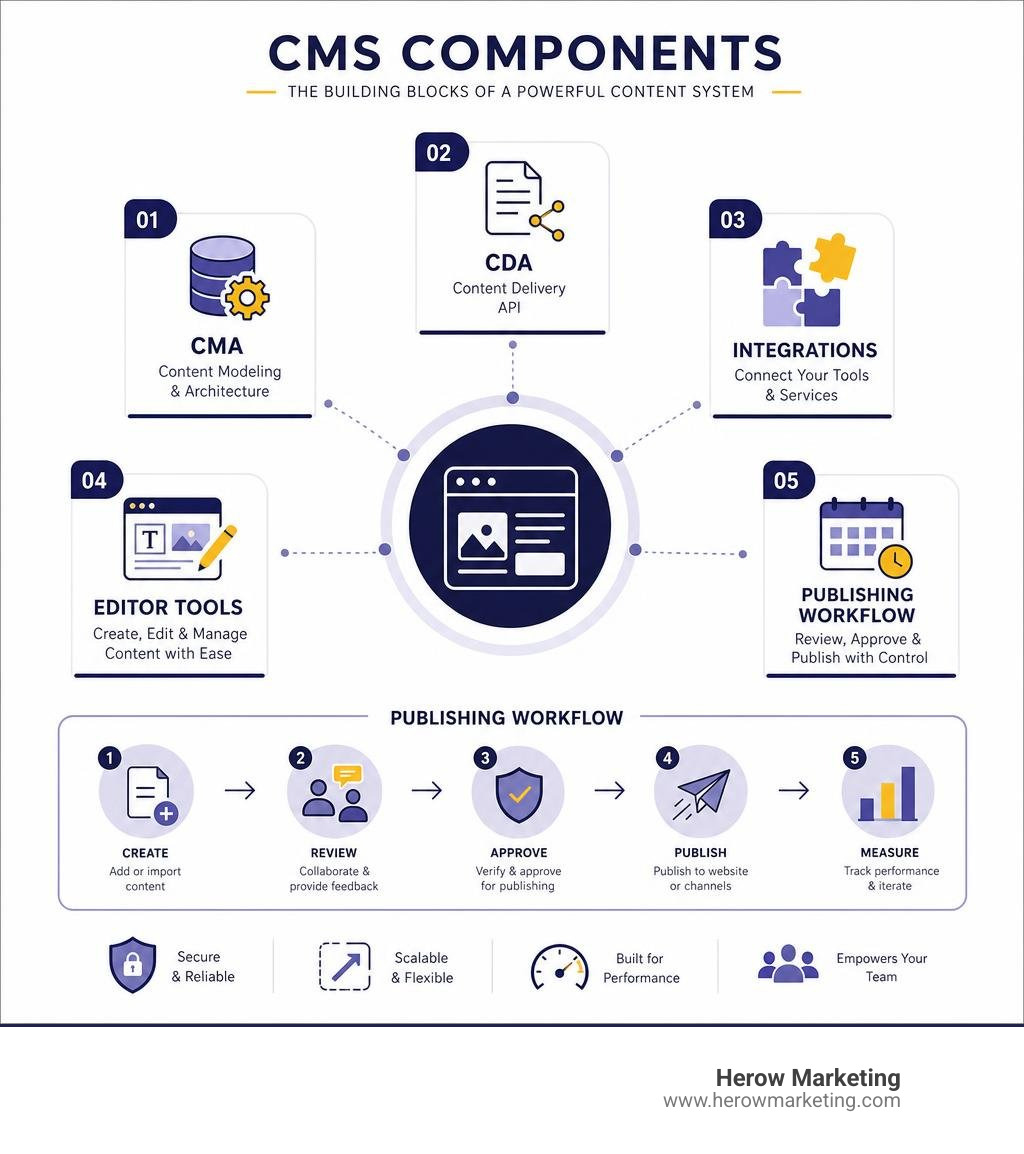
Every Content Management System is fundamentally split into two primary layers that must work in perfect harmony:
- The Content Management Application (CMA): This is the user interface where your writers, editors, and marketers spend their time. It includes the text editors, media libraries, form builders, and settings panels.
- The Content Delivery Application (CDA): This is the engine under the hood. It takes the raw data saved in your database, processes it, and renders it into clean, fast-loading web pages for your visitors.
In a custom-architected system, developers do not rely on bloated, generic database structures. They design custom database schemas and use modular blocks. This means that instead of a massive, unmanageable text area where formatting easily breaks, your editors work with structured, reusable content components.
Additionally, custom plugins and modules are engineered to handle specific tasks — such as calculating complex dynamic pricing or generating interactive layouts — without relying on third-party marketplace plugins that slow down performance and introduce security risks.

Third-Party Integrations and API Connections
A website cannot exist in a vacuum. To drive real business growth, your CMS must seamlessly connect with the other tools your team uses daily. Professional cms development services build secure, high-performing integrations that keep your website data synchronized with your entire business ecosystem.
These integrations typically connect your CMS with:
- Customer Relationship Management (CRM) Systems: Tools like HubSpot or Salesforce to capture leads directly from forms and track user behavior.
- Enterprise Resource Planning (ERP) & Product Information Management (PIM): To sync inventory, product catalogs, and pricing in real time for e-commerce or B2B portals.
- Payment Gateways: Highly secure integrations that comply with strict regulatory standards like PCI-DSS.
- Marketing Automation Platforms: Connecting your publishing calendar to newsletter tools, social channels, and analytics dashboards.
By utilizing custom API connectivity, developers can pull and push data dynamically without slowing down page load speeds. A custom-built system ensures these complex enterprise-grade integrations are designed so that centralized marketing control remains effortless across multiple channels.
Custom CMS vs. Off-the-Shelf Platforms: Making the Right Choice
Choosing the right platform is one of the most consequential decisions your business will make. The table below outlines how custom-built solutions, headless architectures, and off-the-shelf platforms compare across critical business metrics:
| Metric | Off-the-Shelf Platforms | Headless CMS Architecture | Custom CMS Development |
|---|---|---|---|
| Initial Cost | Low to Moderate | Moderate to High | High |
| Long-Term Maintenance | High (due to plugin updates & security patches) | Low | Very Low |
| Publishing Speed | Moderate (often slowed by system bloat) | Extremely Fast | Fast |
| Customizability | Rigid (limited by templates) | Unlimited (decoupled frontend) | Unlimited |
| Security | Vulnerable to generic exploits | High (no direct database access) | High (fully locked down) |
While off-the-shelf platforms are quick to deploy, they often lead to high technical debt. This is why we believe Why Your B2B Web Agency Shouldn’t Be Boring is such an important read — standard templates make your brand look identical to your competitors and limit your ability to scale.
Why Professional CMS Development Services Outperform Out-of-the-Box Solutions
Out-of-the-box platforms are built to satisfy millions of users simultaneously. To achieve this, they pack in generic features, complex codebases, and rigid templates. Over time, businesses attempt to bypass these limitations by stacking on third-party plugins. The result? A fragile, slow website held together by “plugin spaghetti.”
Professional cms development services approach the build from an engineering perspective. Whether using custom WordPress development (utilizing Bedrock-style setups, Composer-managed dependencies, and strict coding standards), Webflow for design-led agility, or modern headless platforms like Sanity and Contentful, the goal is always a clean, future-proof architecture.
By writing clean, semantic code from scratch, developers can reduce technical overhead, eliminate security vulnerabilities, and dramatically improve site performance. This level of customization is why many growing brands turn to professional development services to build platforms that handle enterprise-level traffic without breaking a sweat.
How to Choose the Right CMS Development Services for Your Business
To choose the right path, you must evaluate three key variables:
- Content Volume: Are you managing a 10-page marketing site, or a 10,000-page publishing hub with complex categorization?
- Team Size & Technical Ability: Do you have a dedicated in-house development team, or will non-technical marketing editors manage the site daily?
- Publishing Workflow: Do you require multi-step editorial approvals, multi-language localization, or multi-site management from a single dashboard?
For a deeper dive into choosing the right partner to guide you through these decisions, read our comprehensive guide on How to Hire a B2B Web Development Company Without Regrets.
Key Benefits of Investing in Professional CMS Website Development
Investing in professional CMS website development delivers compounding returns. Modern content systems built by experienced developers can help organizations achieve up to 50% faster content publishing and 30% lower maintenance costs compared to rigid legacy systems.

Empowering Editors with an Intuitive Content Management Workflow
The most common point of failure for any corporate website isn’t the code — it’s the editor experience. When the back-end admin area is confusing and fragile, editors become afraid of making updates. They abandon the system, content grows stale, and marketing velocity drops to zero.
Professional CMS developers treat the editor experience as a product in its own right. They build:
- Custom WYSIWYG & Block Editors: Allowing editors to drag and drop pre-designed, brand-approved components without any risk of breaking the overall site layout.
- Role-Based Access Control (RBAC): Restricting access so writers can only draft posts, editors can review and approve, and administrators can modify core settings.
- Content Versioning & Backups: Allowing teams to preview changes safely and roll back to previous versions with a single click if a mistake is made.
When your publishing workflow is intuitive, your team can launch marketing campaigns, write blogs, and update product information in minutes, rather than waiting days for a web developer to clear a support ticket.
Future-Proofing Your Digital Presence with Headless and Hybrid Architectures
Headless CMS adoption grew by 64% year-over-year in 2024, and it remains a dominant trend. A headless CMS decouples the content repository (the backend) from the presentation layer (the frontend). Your content is stored as raw data and delivered via secure APIs to any device — whether that is a web browser, a mobile app, an IoT device, or an interactive digital kiosk.
This approach offers unparalleled developer flexibility and lightning-fast performance by pairing platforms like Sanity or Strapi with modern React frontends (like Next.js). Headless and hybrid setups allow companies to scale their content delivery infinitely without being tied to a single, monolithic platform.
Furthermore, adopting a modular, API-first architecture ensures that your business can completely redesign its frontend visual brand in the future without having to rebuild your entire content database from scratch.
How CMS Developers Handle Migration, SEO, and Security
Building a beautiful website is only half the battle. To drive business results, your new platform must maintain your existing search engine rankings, keep your data safe, and load instantly on every device.
Zero-Downtime Content Migration and SEO Preservation
Migrating to a new CMS can be stressful. Without a meticulous, developer-led migration strategy, businesses risk losing years of accumulated organic search rankings. A single broken redirect or missing metadata field can cause a devastating drop in traffic.
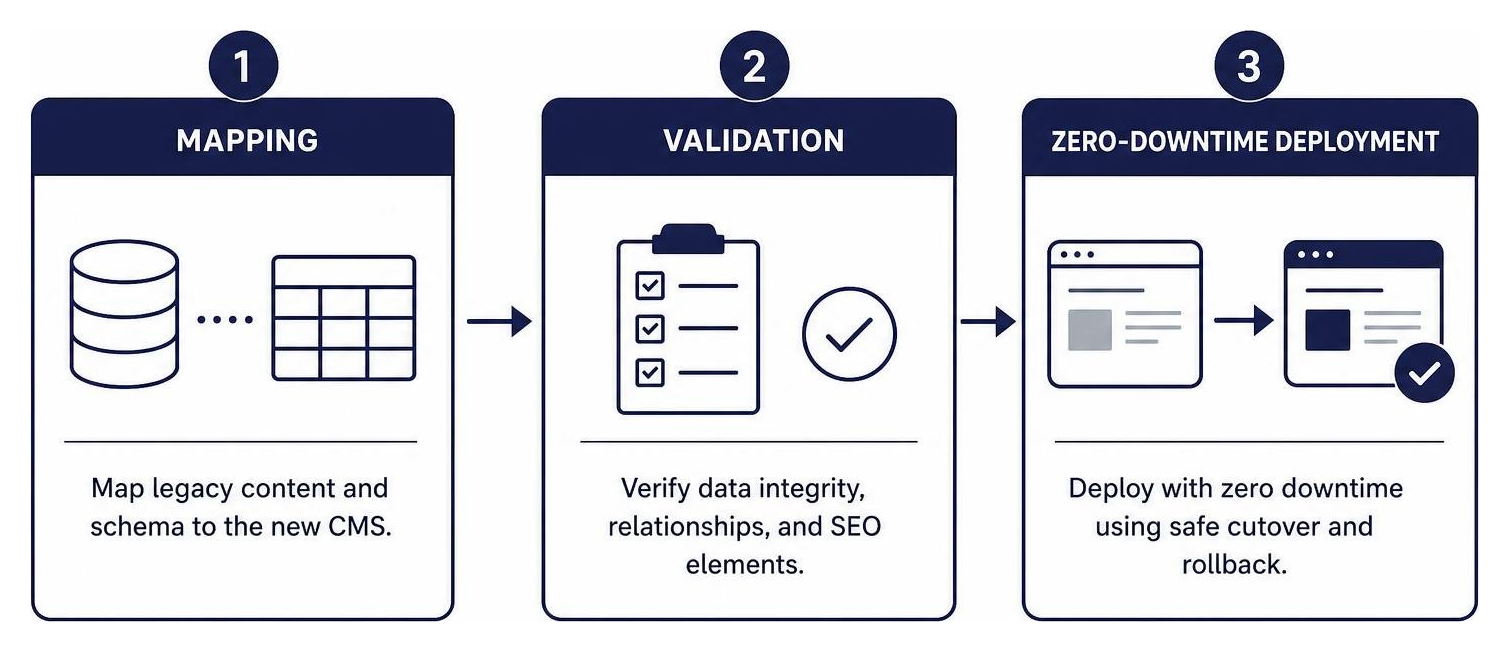
To prevent this, experienced CMS developers execute a structured, multi-step migration process:
- Comprehensive Content Auditing & Mapping: Identifying every active URL, media asset, and metadata field on your legacy system.
- Automated & Validated Migration Scripts: Moving thousands of pages of content into the new database schema without manual copy-paste errors.
- Rigorous Redirect Mapping: Setting up permanent 301 redirects for every altered URL path to preserve search engine equity.
- Technical SEO Integration: Ensuring that clean URL structures, automated XML sitemaps, structured schema markup, and canonical tags are natively generated by the new CMS.
We treat search engine performance as a core foundation of the build process. For a closer look at why this matters, check out our insights on Why SEO-Driven Web Development Is Your Secret Weapon and see how we prevent ranking losses in Web Development SEO Integration: Stop Playing Hide and Seek with Rankings.
By implementing these standards, businesses that migrate to a custom or headless CMS report an average 25% to 40% improvement in overall site performance and SEO rankings.
Enterprise-Grade Security, Compliance, and Performance Optimization
In an era of rising cyber threats, security cannot be an afterthought. Outdated, poorly configured CMS platforms are the primary target for automated hacking scripts.
Professional cms development services secure your digital ecosystem by implementing:
- Multi-Factor Authentication (MFA) & Single Sign-On (SSO): Utilizing secure authentication standards like OAuth 2.0 and SAML.
- Regulatory Compliance: Ensuring your system architecture meets necessary legal frameworks, such as HIPAA for healthcare portals or PCI-DSS for e-commerce checkouts.
- Advanced Code Hardening: Writing custom database queries that prevent SQL injection attacks and cross-site scripting (XSS) vulnerabilities.
- Performance Budgeting: Building advanced caching strategies (like Redis Object Caching), Content Delivery Network (CDN) distributions, and image optimization tools directly into the core system.
Partnering with experienced technical specialists ensures that your platform is fully hardened against security threats from day one, giving your team complete peace of mind.
Frequently Asked Questions about CMS Development
What is the typical timeline and cost for a CMS development project?
Timelines and costs vary significantly depending on the complexity of your site, the platform chosen, and migration needs.
Generally speaking:
- Standard Business Sites (e.g., Webflow or Custom WordPress): Typically take 4 to 8 weeks to design, build, and launch, with costs ranging from $12,000 to $30,000.
- Complex, Custom, or Headless Builds (with migrations and integrations): Typically take 8 to 14 weeks (or more for large enterprise platforms), with investments ranging from $35,000 to $85,000+.
What is a headless CMS and when should a business use it?
A headless CMS separates your content management dashboard (backend) from your website design (frontend). You should use a headless CMS if you need to publish content across multiple channels simultaneously (like a website, mobile app, and client portal), require extreme loading speeds, or want your developers to use modern frontend frameworks like React or Next.js while keeping an easy editing interface for your marketing team.
How do CMS development services ensure the website remains SEO-friendly?
Experienced developers build SEO directly into the platform’s DNA. This includes creating automated sitemaps, customizable URL structures, structured data schemas, fast-loading clean code, mobile-responsive layouts, and easy-to-use editor fields for meta titles, descriptions, and alt text.
Conclusion
A content management system should be a powerful engine that drives your business forward, not a technical bottleneck that holds your marketing team back. Whether you need a highly polished custom WordPress build, an agile Webflow platform, or a modern headless CMS, the key to long-term success lies in treating the editor experience with the same care as the frontend design.
At Herow Marketing, based in Bethlehem, PA, we combine technical web engineering with a time-tested strategic playbook. We don’t just build websites; we create custom digital ecosystems designed to scale. With full transparency via our monthly data reports, we make sure your technical investments translate into measurable, real-world business growth.
Ready to build a content platform your team will actually love using? Partner with Herow Marketing for Web Development today, and let’s build something exceptional together.