


Content Creation and Management 101: Stop Going Crazy and Start Creating
Content Creation and Management 101: Stop Going Crazy and Start Creating
Content Creation and Management: Why Most Small Businesses Are Doing It the Hard Way
Content creation and management is the end-to-end process of planning, producing, organizing, publishing, and maintaining digital content to grow your business online.
Here’s a quick breakdown of what it actually involves:
| Phase | What It Means |
|---|---|
| Planning | Setting goals, researching topics, building a content calendar |
| Creation | Writing, designing, filming, or recording your content |
| Management | Organizing files, workflows, and team responsibilities |
| Distribution | Publishing across your chosen channels |
| Measurement | Tracking what works and cutting what doesn’t |
Sound like a lot? It is — especially when you’re running a business at the same time.
Here’s the reality: demand for content is exploding. According to Adobe research, content demand is expected to double at large enterprises, and 99% of big companies are producing more content now than they were two years ago. That pressure doesn’t stay at the enterprise level. It trickles down fast.
For small business owners, that usually means one thing: overwhelm.
You’re posting when you remember to. Your brand looks different on Instagram than it does on your website. You’ve got a folder somewhere called “content ideas” that you haven’t opened in three months. Sound familiar?
The good news is that managing content without losing your mind is absolutely possible — you just need a smarter system, not more hours in the day.
I’m Gianna Heron, founder of Herow Marketing, and my background spans professional ballet, Wall Street finance, creative direction, and brand strategy — all disciplines that taught me how to turn creative output into measurable results, which is exactly what great content creation and management requires. Let’s build that system together.
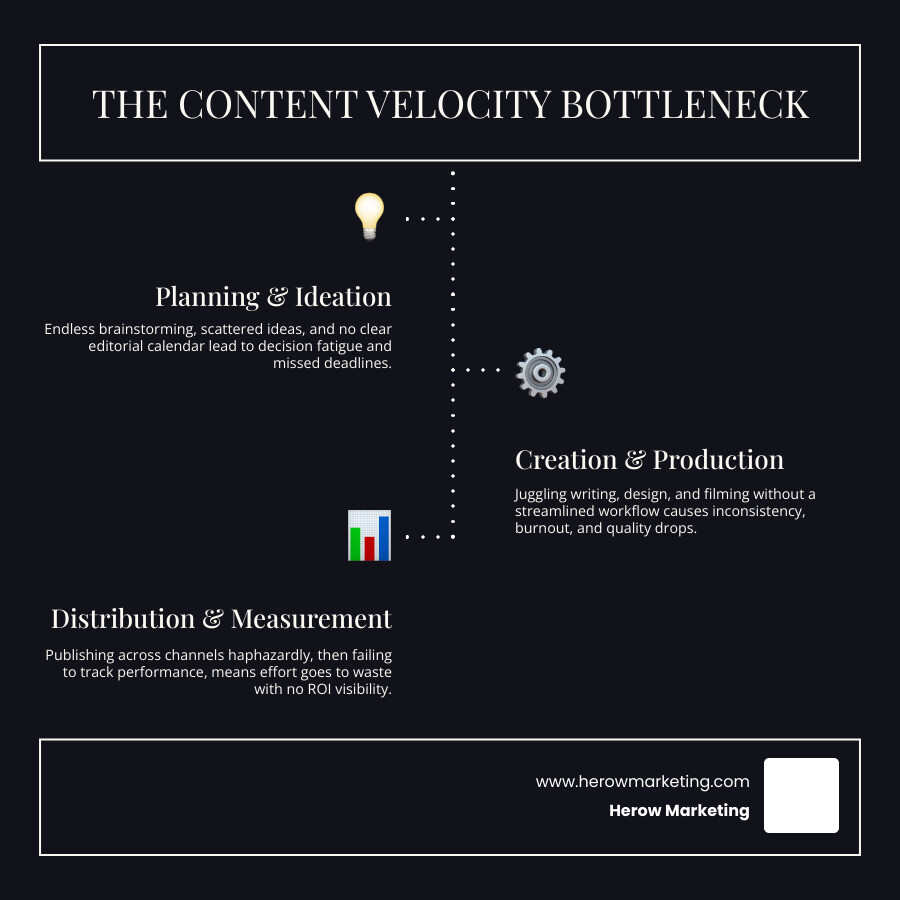
Content creation and management terms made easy:
1. Demystifying Content Creation and Management
To stop going crazy, we first need to understand the beast we are trying to tame. Too many business owners treat content like a series of random, frantic chores. One day you realize you haven’t posted on social media in a week, so you scramble to throw together a graphic. The next day you realize your website’s home page still references an offer from last year.
This reactive approach is a recipe for creative burnout and brand inconsistency.
What is Content Creation and Why Does It Matter?
At its core, content creation is the strategic process of identifying topics that appeal to your target buyer persona, creating written or visual assets around those ideas, and making that information easily accessible to your audience.
But why do we do it? We do it because high-quality, educational content builds brand trust and drives long-term audience engagement. In July 2026, consumers are smarter and more selective than ever. They do not want to be constantly pitched to; they want to be educated, entertained, and helped. When you consistently publish valuable content, you position your brand as the go-to authority in your industry.
Whether you run a local service business here in Bethlehem, PA, or manage a growing e-commerce brand, your digital presence is your handshake. If you want to make your website stand out, utilizing specialized Top Content Creation Websites to Make Your Site Pop is a fantastic starting point to elevate your visual and written appeal.
The Content Management Lifecycle Explained
If content creation is the spark, content management is the engine that keeps the fire burning. Content management is the end-to-end framework of organizing, updating, and maintaining your digital assets.
A healthy content management lifecycle consists of several distinct stages:
- Planning: Researching keywords, brainstorming topics, and mapping them to an editorial calendar.
- Creation: Writing, designing, filming, and editing your assets.
- Storage: Saving your work in a centralized, secure location with clear, searchable metadata.
- Workflow & Editing: Routing drafts through team members for quality control, compliance, and brand alignment.
- Publishing: Distributing your content to the right channels at the optimal times.
- Removal & Archiving: Deleting outdated content or archiving assets to keep your digital ecosystem clean.
Ignoring the back-end of this lifecycle is how companies end up publishing “rogue content”—outdated pricing, off-brand messaging, or broken links that damage credibility. To keep your digital documents interactive, responsive, and easily readable on any device without forcing users to pinch and zoom, platforms like Platform: Content Creation – Foleon help businesses transition away from static PDFs into modern, machine-readable HTML5 formats.
2. Developing a Burnout-Free Strategy and Workflow
The secret to sustainable content production is separating the strategy from the execution. If you are trying to decide what to write, how to write it, where to post it, and how to design it all in the same afternoon, you will burn out before the week is over.

Key Steps in Content Creation and Management Strategy
Before you type a single word, you need a blueprint. A documented content strategy ensures that every piece of creative work you produce directly supports your business goals. Here is how we build one:
- Establish SMART Goals: “Get more traffic” is not a plan. Instead, aim for something measurable: “Increase organic website traffic by 20% over the next three months by publishing three highly targeted industry articles per week.”
- Conduct a Content Audit: Look at what you already have. Build a simple spreadsheet categorizing your existing pages, posts, and downloads by target keywords, customer personas, and performance metrics. This helps you identify gaps in your current inventory.
- Map Out Topic Clusters: Instead of writing random articles, build topic clusters. Create one comprehensive “pillar” piece (e.g., a complete guide to your service) and support it with multiple shorter “sub-topic” pieces that link back to the pillar.
- Align with Business Growth: Your content should serve as the ultimate fuel for your broader marketing initiatives. For a deeper look at how to tie these elements together, check out The Complete Guide to Small Business Marketing.
Choosing the Right Formats for Your Audience
Not all content formats are created equal, and you do not need to be on every single platform to succeed. The key is choosing the formats that match your buyer personas’ habits:
- Short-Form Video: Perfect for platforms like TikTok, Instagram Reels, and YouTube Shorts. These are highly effective for capturing quick attention and humanizing your brand.
- Interactive Graphics and PDFs: Ideal for B2B audiences who need to digest complex data or workflows without getting bored.
- Podcasts: Great for building deep, conversational authority and capturing passive listening time (like during commutes).
- SEO-Optimized Blogs: The gold standard for driving consistent, long-term organic search traffic to your website.
For example, if you are in a highly visual, relationship-driven industry, your format choices will look very different than if you are selling enterprise software. To see how this plays out in a specific sector, take a look at our guide on From Listings to Likes: Real Estate Content Creation for Modern Agents.
Organizing Your Content Workflow Effectively
To keep your sanity intact, you must establish a structured creative workflow. At Herow Marketing, we recommend three core practices:
- Separate Ideation from Creation: Never sit down at a blank screen trying to generate an idea and write a draft at the same time. Maintain a centralized “Content Idea Vault” (using simple tools like Trello, Notion, or Google Sheets) where you dump raw ideas, headlines, and inspiration the moment they strike. Let them sit and mature before you start writing.
- Batch Your Production: Stop creating content day-by-day. Instead, dedicate specific blocks of time to do one thing. Spend Monday outlining, Tuesday writing, and Wednesday designing graphics. Batching keeps your brain in a single cognitive zone, drastically reducing the time it takes to produce work.
- Build a Content Bank: Always keep a reserve of evergreen content ready to go. If a busy week hits or an employee goes on vacation, your content bank ensures your brand stays active without causing a last-minute panic. For a breakdown of how to coordinate these schedules across different networks, explore our review of One Dashboard to Rule Them All: Top Social Media Tools.
Scaling Content Production Without Increasing Headcount
You do not need a massive team to scale your digital footprint. To produce more content without blowing up your payroll, focus on operational efficiency:
- Use Templates for Everything: Create reusable templates for blog layouts, social media graphics, video scripts, and email newsletters. This ensures visual consistency and cuts design time in half.
- Define Clear User Roles: Even in a small team, establish who is the creator, who is the editor, and who has final publishing approval. This prevents bottlenecks and ensures quality control.
- Repurpose Existing Assets: Turn a single comprehensive blog post into five social media graphics, a short-form video script, and an email newsletter.
If you are looking to build these production capabilities in-house, check out our insights on the 10 Essential Skills to Become a Media Production Company to help structure your internal workflows like a professional studio.
3. The Modern Tech Stack: CMS, CRM, and AI Integration
Your team is only as fast as the tools they use. Juggling a dozen disconnected platforms leads to lost files, missed deadlines, and miscommunication.
Essential Tools for Content Creation and Management
A streamlined marketing stack doesn’t have to be expensive, but it does need to be integrated. Here are the core categories of tools your business needs:
- Visual Design & Video Editing: Tools like Canva, Adobe Express, and CapCut allow non-designers to quickly build high-quality visual assets and add automated captions to short-form videos.
- Project Management & Collaboration: Trello, Monday.com, and Slack keep your editorial pipeline visible, helping your team track drafts, approvals, and publication dates in real-time.
- Enterprise Content Orchestration: For rapidly growing teams that need to coordinate campaigns across multiple divisions, utilizing a dedicated workspace like the Optimizely Content Marketing Platform (CMP) helps centralize planning, automate approvals, and eliminate redundant tools.
CMS vs. CRM: How They Differ and Complement Each Other
A common mistake small businesses make is confusing their Content Management System (CMS) with their Customer Relationship Management (CRM) platform. While they sound similar, they perform completely different, yet complementary, roles.
| Feature | Content Management System (CMS) | Customer Relationship Management (CRM) |
|---|---|---|
| Primary Focus | Managing creative assets, web pages, and blog posts. | Tracking customer interactions, sales pipelines, and leads. |
| Content Type | Unstructured content (images, videos, text documents). | Structured content (contact details, purchase histories, deals). |
| Goal | Attracting and educating traffic. | Converting traffic into revenue and tracking ROI. |
If your CMS and CRM do not talk to each other, you suffer from “lead leakage.” A visitor might read an amazing blog post on your CMS, but if their interaction isn’t tracked in your CRM, your sales team won’t know to follow up with the right context. Integrating these systems allows you to align your creative assets directly with the customer journey. To understand how to leverage these digital tools to grow your business online, read our guide on Digital Growth: Best Ways to Market a Small Business Online.
Leveraging AI and Automation Responsibly
AI tools like ChatGPT, Claude, and Gemini have changed the game for content creation. However, relying on AI to write entire blog posts without human oversight is a fast track to generic, low-value content that search engines and modern buyers ignore.
Instead, use AI to supercharge your existing workflow:
- Brainstorming & Outlining: Use AI to generate headline variations or draft structured outlines based on top-performing search queries.
- Automated Compliance and Style Checks: Set up AI guardrails to scan your drafts for brand voice alignment, reading level, and banned phrases before they reach a human editor.
- Intelligent Content Activation: For larger organizations dealing with massive volumes of documents, platforms like IBM Content Cortex | Intelligent Content Platform use agentic AI to centralize, enrich, and secure enterprise content, making it instantly searchable and safe from data leakage.
4. Measuring Performance and Proving Content ROI
At the end of the day, content is an investment, not a hobby. If you cannot prove that your content creation and management efforts are driving business growth, you are just making noise.
Best Practices for Tracking Content Performance
To prove the financial value of your content to your bottom line, you must move beyond “vanity metrics” like likes and page views. Focus on metrics that show actual business impact:
- Content Value (CPC Equivalency): Calculate what your organic search traffic would have cost if you had bought it through paid ads. Multiply your organic traffic by the channel-equivalent Cost-Per-Click (CPC) for those keywords.
- Pipeline Attribution: Track how many leads interacted with a specific blog post, video, or eBook before converting into a paying customer.
- Operational Velocity: Measure your “brief-to-publish” timeline. Streamlining your editorial workflow reduces administrative overhead and gets your content to market faster.
By utilizing advanced frameworks like the Content Marketing Platform: Scale expertise, not drafts | Contently , businesses can easily calculate their total Content Value, streamline upstream compliance, and connect creative assets directly to downstream revenue events in their CRM.
Frequently Asked Questions
What is the difference between a content creation tool and a CRM?
Content creation tools (like Canva, CapCut, or ChatGPT) are used to generate the actual creative assets, such as graphics, videos, and written copy. A CRM (Customer Relationship Management system) is used to track customer interactions, manage sales pipelines, and measure the revenue and ROI generated by those creative assets.
How do you scale content in highly regulated industries without legal bottlenecks?
To scale content in regulated sectors (like finance, real estate, or healthcare) without constant legal delays, you must build compliance upstream. This means embedding style guides, regulatory rules, and banned phrases directly into your creative briefs. Additionally, working with credentialed industry experts and maintaining a clear, timestamped audit trail ensures that legal reviews are quick sign-offs rather than complete rewrites.
How can content be optimized for AI-powered search engines (AEO)?
To optimize your content for Answer Engine Optimization (AEO) and LLMs (like GPT, Claude, and Perplexity), you must make your website highly machine-readable. Use clean semantic HTML, implement structured JSON-LD schema markup, and write clear, direct answers to the specific questions your audience is typing into search engines.
Conclusion
Managing a successful content engine doesn’t require a massive team or a million-dollar budget. It requires a commitment to structure, a clear understanding of your audience, and an integrated tech stack that connects your creative work directly to your business goals.
At Herow Marketing, based right here in Bethlehem, PA, we help businesses cut through the operational chaos of digital marketing. Our time-tested strategic playbook and fully transparent monthly data reports ensure that your content creation and management efforts translate into measurable, real-world growth.
Stop going crazy trying to do it all yourself. Let us build and manage a high-performing content engine for your business. Explore Herow Marketing Services today, and let’s start creating content that actually converts.