


How to Master Advanced Attribution Modeling Without Losing Your Mind
How to Master Advanced Attribution Modeling Without Losing Your Mind
Why Advanced Attribution Modeling Is the Key to Smarter Marketing Spend
Advanced attribution modeling is the practice of using algorithmic and statistical methods — rather than fixed rules — to assign conversion credit across every touchpoint in a customer’s journey, so you can see exactly which marketing efforts are actually driving results.
Quick answer: What is advanced attribution modeling?
| Concept | What It Means |
|---|---|
| What it is | A data-driven approach to measuring which marketing touchpoints contribute to conversions |
| How it differs from basic models | Uses machine learning and statistics instead of rigid rules like “last click gets all credit” |
| Why it matters | Stops you from over-investing in channels that look good on paper but don’t actually drive sales |
| Common methods | Data-driven attribution, Shapley values, Markov chains, Marketing Mix Modeling (MMM) |
| Who needs it | Any business running campaigns across more than one or two channels |
Here is the uncomfortable truth most marketing platforms won’t tell you: your analytics dashboard is probably lying to you — not on purpose, but because the default attribution model it uses is far too simple for how real customers actually behave.
Today’s buyer doesn’t see one ad and buy. They click a Facebook post, read a blog, ignore an email, search Google three days later, and then convert. If your attribution model gives 100% of the credit to that final Google search, you’ll keep cutting the channels that were doing the heavy lifting all along.
That’s the core problem advanced attribution modeling solves.
I’m Gianna Heron, founder of Herow Marketing — and my background in Wall Street finance, where I helped business owners map spend to real ROI, is exactly what shaped how I approach advanced attribution modeling as a growth tool, not just a reporting checkbox. Let’s break this down in plain language so you can start making smarter budget decisions starting today.
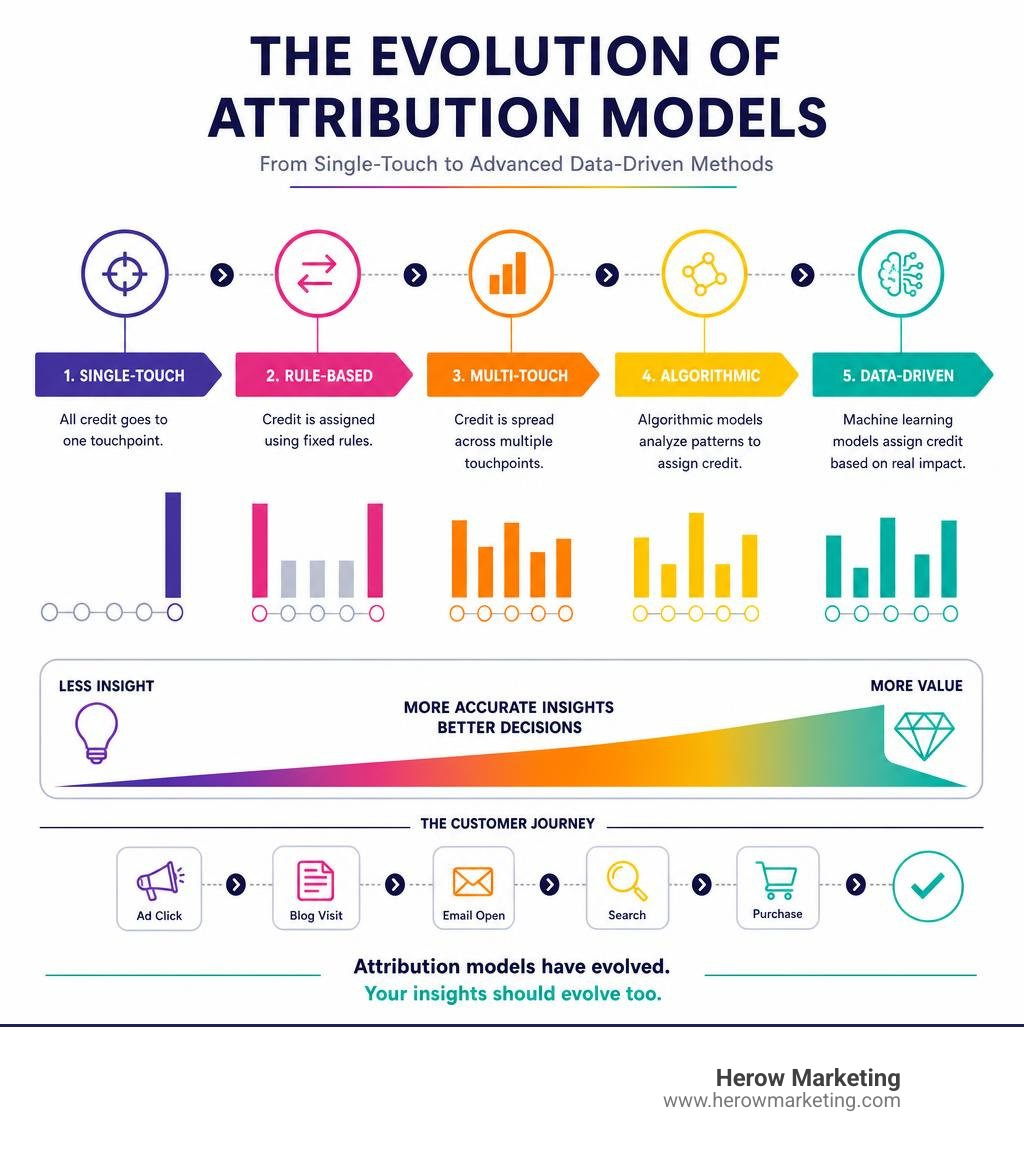
The Failure of Traditional Rules and the Rise of Advanced Attribution Modeling
For years, digital marketing operated on a simple promise: everything is trackable, so everything is knowable. But as the digital ecosystem grew, that promise cracked. We ended up with a fragmented reality where your Facebook dashboard claims 50 conversions, Google Analytics claims 35, and your email marketing platform swears it drove 20 of those exact same sales.
This happens because traditional rule-based models operate in silos. They use static, pre-determined rules to hand out conversion credit, completely ignoring the sheer complexity of the modern customer journey.
| Feature | Rule-Based Models | Advanced Attribution Modeling |
|---|---|---|
| Credit Assignment | Static and arbitrary (e.g., 100% to first or last touch) | Algorithmic and dynamic based on actual incremental impact |
| Journey View | Linear and oversimplified | Non-linear, cross-channel, and multi-device |
| Handling of Cookie Loss | Fails completely due to broken tracking links | Resilient, utilizing machine learning and aggregated signals |
| Decision Support | Tactical (which ad got the last click?) | Strategic (how does our media mix drive long-term pipeline?) |
Today, the customer journey looks less like a neat funnel and more like a choose-your-own-adventure novel. This is why more and more brands are abandoning simplistic tracking. In fact, research shows that 52% of marketers use multi-touch attribution (MTA) models. The same data reveals that MTA users are more satisfied than marketers who don’t use MTA when it comes to tracking campaign spend and allocating marketing budget.
But even standard MTA has its limits. If you are still using static rules to divide credit, you are essentially guessing with extra steps. To build marketing campaigns that actually scale your business, you need to transition to advanced attribution modeling.
Before you can build an advanced model, however, you need a clean foundation. If your analytics setup is messy, your attribution will be too. You can learn more about setting up your first analytics dashboard to ensure your data pipeline starts on the right foot.
The Limitations of Single-Touch and Static Multi-Touch Models
To understand why advanced models are necessary, we have to look at the limitations of the models that came before them. Traditional attribution models generally fall into two categories: single-touch and static multi-touch.
Single-touch models are the ultimate oversimplifiers:
- First-Touch Attribution: Gives 100% of the credit to the very first interaction. While great for measuring top-of-funnel awareness, it completely ignores what actually convinced the user to buy.
- Last-Touch (or Last-Click) Attribution: Gives 100% of the credit to the final interaction. It is the default for many platforms, but it is systematically biased. It overvalues bottom-funnel channels like branded search or direct traffic while starving the top-funnel channels that introduced the customer to your brand in the first place.
Recognizing these flaws, marketers introduced static multi-touch models:
- Linear Attribution: Distributes credit equally across all touchpoints. If a customer interacts with five channels, each gets 20% of the credit. The problem? It assumes a random blog post view has the exact same impact as a high-intent demo request.
- Time Decay: Gives more credit to touchpoints that occurred closer to the time of conversion. This works well for short sales cycles, but it can severely undervalue long-term nurturing efforts.
- Position-Based (U-Shaped or W-Shaped): Typically gives 40% of the credit to the first touch, 40% to the last touch, and splits the remaining 20% among the middle interactions. W-shaped models add a third milestone, often crediting lead creation.
While these models are a step up from last-click, they are still just guesses dressed up as math. They apply rigid, arbitrary percentages to every customer journey, regardless of whether those touchpoints actually influenced the purchase decision. For a deeper dive into how these legacy models operate in standard platforms, check out Google’s guide on standard attribution models.
Transitioning to Advanced Attribution Modeling: A Step-by-Step Roadmap
Moving away from static rules and transitioning to advanced attribution modeling requires a deliberate, step-by-step approach. You cannot simply flip a switch; you must build a robust data infrastructure that can support algorithmic calculations.
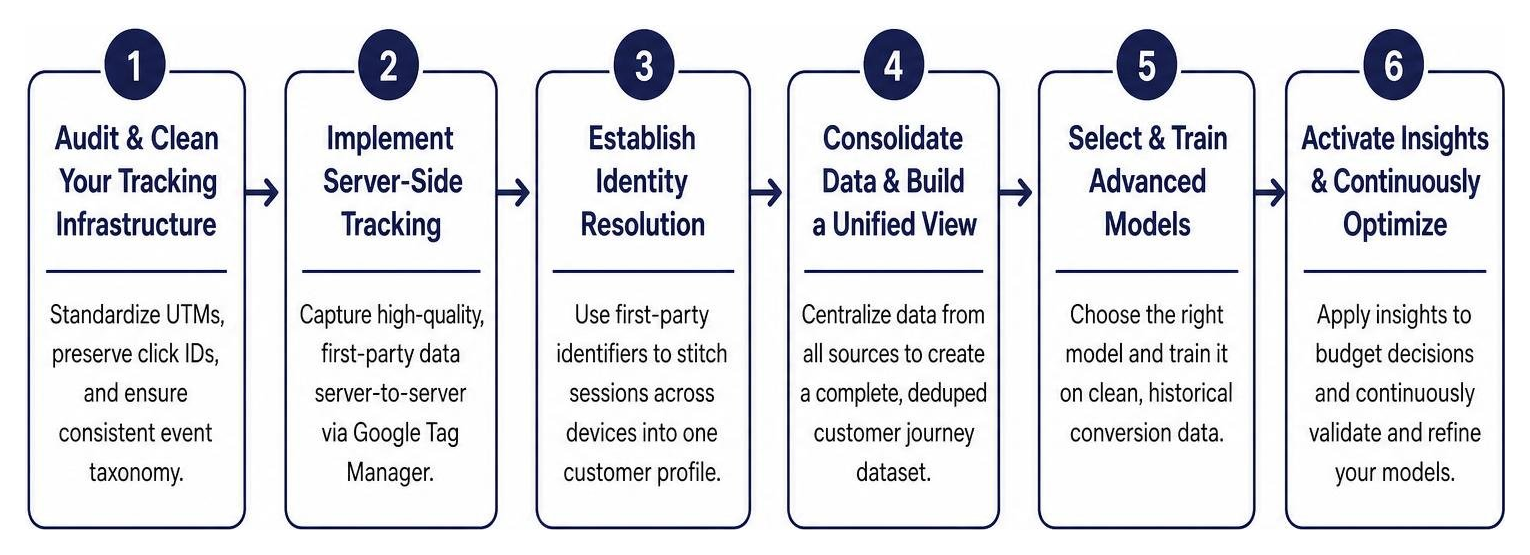
Here is how we guide our partners through this transition:
- Audit and Clean Your Tracking Infrastructure: Before writing a single line of code or training a model, you must ensure your tracking is airtight. This means standardizing your UTM parameters, preserving click IDs (like
gclidandfbclid) across cross-domain hops, and ensuring your event taxonomy is perfectly consistent. If you aren’t sure where to start, you can stop guessing and start auditing your website tracking to find and fix broken pipelines. - Implement Server-Side Tracking: Browser-based tracking is dying due to ad blockers and privacy protocols. Implementing server-side tracking via Google Tag Manager ensures you capture high-quality, first-party data directly from your server to your marketing platforms.
- Establish Identity Resolution: To model multi-touch journeys, you must connect the dots between devices and sessions. Using first-party identifiers, such as hashed emails and phone numbers, allows you to stitch fragmented sessions into a single, cohesive customer profile.
- Account for Your Sales Cycle Length: The way you build your model depends heavily on how long it takes a customer to buy. If your sales cycle exceeds 90 days, standard tracking windows will cut off your data. You must configure your data retention windows (and export raw data to tools like BigQuery) to preserve the full journey.
Algorithmic Power: How Data-Driven Models Work
Once your data foundation is secure, you can unleash the real engine of modern measurement: data-driven attribution (DDA).

Unlike rule-based systems, algorithmic attribution doesn’t rely on human assumptions. Instead, it uses machine learning and statistical modeling to analyze your historical customer journeys. The model looks at both converting paths and non-converting paths to calculate the exact marginal contribution of each touchpoint.
To do this, data-driven models use counterfactual analysis. The algorithm essentially asks: “If we removed this specific Facebook ad from the customer’s journey, how much would the probability of conversion decrease?”
If the conversion probability barely drops, that Facebook ad receives very little credit. If the probability plummets, the ad receives a high share of the credit. This dynamic, self-learning approach is what makes DDA the modern standard for digital measurement. To explore the technical mechanics of these algorithms further, you can discover how advanced machine learning models power attribution.
Shapley Values and Markov Chains in Action
To assign this fractional credit accurately, advanced models rely on two primary mathematical frameworks borrowed from cooperative game theory and probability theory: Shapley values and Markov chains.
Shapley Value Attribution
Originating from game theory, the Shapley value is a method of distributing total gains among players based on their individual contributions to a team’s success.
Think of your marketing channels as a kitchen staff preparing a gourmet meal (the conversion):
- The prep cook (awareness ad) chops the vegetables.
- The sous chef (nurture email) cooks the sauce.
- The head chef (branded search ad) plates the dish and sends it to the table.
Who gets credit for the delicious meal? Under last-touch, the head chef gets 100% of the glory. Under Shapley value modeling, the algorithm reconstructs every possible combination of these cooks working together and working alone. By analyzing thousands of journeys, it calculates the average marginal value that the prep cook adds to the kitchen. This ensures every channel is credited based on its true cooperative value.
Markov Chain Models
Markov chains take a different approach, viewing the customer journey as a state transition model. It maps out your marketing channels as a network of “states” and calculates the probability of a user moving from one state to another (e.g., from “Social Ad” to “Blog Post” to “Conversion”).
To determine the value of a channel, the model uses a concept called the Removal Effect. The algorithm mathematically “removes” a channel from the network and measures how many conversions are lost because that pathway was blocked. If removing your email newsletter causes conversions to drop by 30%, then email is assigned 30% of the conversion credit.
Markov chains are highly dynamic and work exceptionally well for complex, multi-channel e-commerce funnels where users bounce back and forth between different touchpoints.
The Role of AI and the Risks of Pure Predictive Accuracy
As artificial intelligence becomes deeply integrated into ad platforms, it plays an increasingly vital role in advanced attribution. AI excels at processing massive datasets, generating synthetic data to fill tracking gaps left by privacy changes, and predicting future customer behavior in real time.
However, relying solely on AI’s predictive accuracy carries a major risk: confusing correlation with causation.
An algorithm trained purely to predict conversions might notice that users who receive transactional shipping emails convert at a 99% rate. If the model is not grounded in a causal framework, it might recommend that you pour your entire marketing budget into shipping emails. But common sense tells us that shipping emails don’t cause conversions; they are a result of conversions.
This is why advanced modeling must measure incrementality — proving that a marketing channel actually drove a sale that would not have happened otherwise. Without incrementality testing, algorithms will naturally shift budget toward bottom-funnel channels that are simply intercepting existing demand, rather than creating new customers.
To keep your models honest, you must regularly translate these complex data points into human-readable business insights. For a practical guide on how to present these findings to your team, read our guide on how to create a marketing campaign analysis report.
Triangulating Truth: Integrating MMM, MTA, and Incrementality
No single attribution model is perfect. Digital multi-touch attribution is incredible for tactical, real-time optimization, but it is blind to offline factors like television ads, print media, or economic shifts.
To find the absolute truth, mature brands use a unified measurement framework that triangulates three distinct methodologies:

- Multi-Touch Attribution (MTA): Provides real-time, user-level digital tracking. It is highly tactical, helping your media buyers optimize creative assets and adjust daily bidding strategies.
- Marketing Mix Modeling (MMM): Offers a top-down, strategic view. It uses aggregated statistical regression to analyze how overall marketing spend, seasonality, and external economic factors drive revenue.
- Incrementality Testing: The gold standard of validation. By running controlled experiments — such as geo-based holdout tests where you turn off ads in specific zip codes — you can prove the exact lift a channel provides.
By combining these three layers, you create a system of checks and balances. If your MTA model claims a Facebook campaign is driving a 5x ROAS, but an incrementality test shows a 0x lift, you know your digital tracking is capturing organic demand rather than driving incremental growth. To explore how to build this unified framework in detail, check out these advanced insights on multi-touch and MMM integration.
How Marketing Mix Modeling (MMM) Solves the Privacy Problem
In 2026, privacy is no longer an afterthought — it is the defining constraint of marketing measurement. With the deprecation of third-party cookies and strict regulations like GDPR and CCPA, user-level tracking has become increasingly difficult.
This is where Marketing Mix Modeling (MMM) shines. Because MMM operates entirely on aggregated data rather than individual user tracking, it is 100% privacy-compliant.
MMM doesn’t care about cookies, device IDs, or click paths. Instead, it looks at historical correlations. For example, it analyzes how weekly spend on Google Search and local radio ads correlates with weekly sales over time, while controlling for variables like holidays, weather, and competitor pricing.
Historically, traditional MMM was slow, expensive, and required two years or more of historical data for accurate modeling. However, modern open-source machine learning libraries have democratized MMM, allowing brands to run agile, near-real-time models with much smaller datasets. This top-down view is essential for integrating offline data and managing high-level budget allocations without relying on invasive user-level tracking.
To keep these high-level insights organized and actionable for executive leadership, we recommend automating your reporting flows. You can read the ultimate guide to automated monthly report dashboards to see how to bring MMM and MTA data into a single, clean view.
Selecting the Right Platform for Advanced Attribution Modeling
Choosing an attribution platform is one of the most critical decisions your organization will make. The wrong platform will lock you into proprietary black boxes, while the right platform will serve as an open, flexible foundation for growth.
When evaluating platforms, look for the following criteria:
- Data Integration Capabilities: Can the platform seamlessly ingest data from your CRM, ad networks, server-side tags, and offline sales systems?
- Model Flexibility: Does it allow you to customize credit rules, or are you forced to use their pre-built models?
- Privacy Compliance: Does the platform offer consent-aware modeling and server-side integration to respect user privacy choices?
- Customer Journey Analytics: Platforms like Adobe Customer Journey Analytics allow you to attribute value to non-traditional touchpoints, such as chatbot interactions, support tickets, and webinar attendance.
To see what clean, professional reporting looks like across various industries, explore the best marketing report samples for every campaign type to help guide your platform selection. For more details on how unified platforms handle complex customer data, refer to Adobe’s guide to customer journey analytics and attribution.
Frequently Asked Questions About Advanced Attribution Modeling
What is the difference between rule-based and data-driven attribution?
Rule-based attribution relies on static, human-defined rules (like “give the last click 100% of the credit”) to distribute conversion value. Data-driven attribution uses machine learning algorithms to analyze both converting and non-converting paths, dynamically assigning credit based on a touchpoint’s actual statistical contribution to the conversion probability.
How does privacy regulation affect advanced attribution modeling in 2026?
Privacy regulations and technical changes (like cookie deprecation and tracking restrictions) make user-level tracking highly fragmented. Advanced attribution modeling adapts by shifting toward first-party data strategies, server-side tracking, probabilistic modeling, and aggregated measurement frameworks like Marketing Mix Modeling (MMM), which do not rely on individual user tracking.
Why should businesses combine MMM with multi-touch attribution?
Combining MMM with multi-touch attribution allows you to balance strategic and tactical decision-making. MTA provides the granular, real-time data needed to optimize digital campaigns and creative assets week-to-week, while MMM offers a privacy-safe, holistic view of how all marketing channels (including offline media) and external factors drive long-term business growth.
Conclusion
Mastering advanced attribution modeling isn’t about finding a single, perfect formula that solves all your tracking problems forever. It is about building a disciplined measurement strategy that embraces data transparency, respects user privacy, and focuses on driving real, incremental business growth.
At Herow Marketing, we believe that measurement should be a growth engine, not a confusing administrative chore. Our Bethlehem, PA-based team uses a time-tested strategic playbook to clean up your data tracking, build custom attribution frameworks, and deliver full transparency through clear monthly reports.
If you are ready to stop guessing which ads are actually driving revenue and start scaling your business with confidence, we are here to help. Partner with Herow Marketing for advanced SEO and analytics services and let’s unlock the true potential of your marketing spend together.