
How to Market Your Small Business Like a Pro
How to Market Your Small Business Like a Pro
Why Most Small Businesses Struggle to Get Marketing Right
The best ways to market your small business come down to a focused system — not doing everything at once.
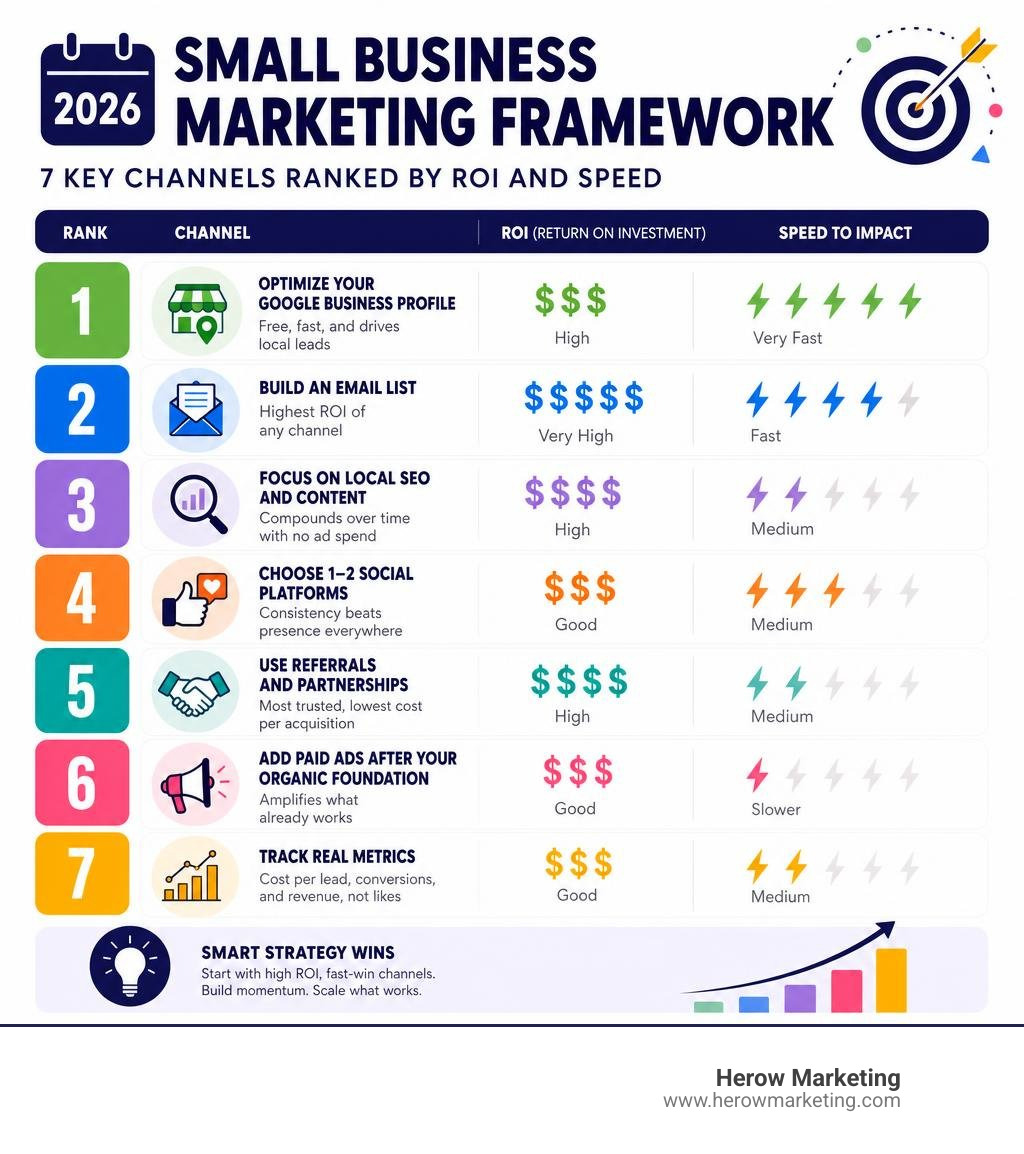
Quick answer: The most effective small business marketing strategies in 2026
- Optimize your Google Business Profile — free, fast, and drives local leads
- Build an email list — highest ROI of any channel at $36 per $1 spent
- Focus on local SEO and content — compounds over time with no ad spend
- Choose one or two social platforms — consistency beats presence everywhere
- Use referrals and partnerships — most trusted, lowest cost per acquisition
- Add paid ads after your organic foundation is set — amplifies what already works
- Track real metrics — cost per lead, conversions, and revenue, not likes
Here’s a hard truth: most small business owners aren’t failing at marketing because they aren’t trying. They’re failing because they’re running disconnected tactics with no clear system behind them.
One month it’s Instagram. The next it’s a Google Ad. Then a flyer. Then nothing for six weeks.
Sound familiar?
The marketing landscape in 2026 has also gotten more complex. Nearly 98% of consumers use the internet to find local businesses. Google now answers questions with AI before showing any links. And 66% of customers expect businesses to understand their individual needs — not just blast generic promotions.
The bar is higher. But so is the opportunity — especially for small businesses willing to build smart, focused systems instead of chasing every new trend.
My name is Gianna Heron, and my background spans professional performance, Wall Street finance, brand creative direction, and digital marketing — giving me a rare lens on what actually drives growth, which is exactly what this guide to the best ways to market your small business is built on. Whether you’re starting from zero or trying to make sense of what isn’t working, this guide gives you a clear, actionable framework you can execute with limited time and budget.
Easy best ways to market your small business glossary:
The Best Ways to Market Your Small Business in 2026
To build a marketing strategy that lasts, we must first understand that modern marketing is divided into “rented” channels and “owned” assets. Paid advertising is rented space; the moment you stop paying, the leads dry up. On the other hand, organic foundations like your website, your search visibility, and your email list are owned assets. They compound in value over time and continue to work for you even when budgets are tight.
In 2026, the most effective digital marketing strategies for small businesses focus heavily on securing this organic foundation. With search engines shifting toward AI-assisted results and zero-click queries, having a direct, high-value connection to your audience is non-negotiable.
Rather than spreading ourselves thin across every new social media app, the best approach is to build a highly optimized, conversion-focused website and pair it with first-party data collection. First-party data—such as email addresses and phone numbers collected directly with customer permission—protects your business from changing algorithms.
By focusing on a minimum viable marketing mix, you can outcompete larger businesses with much bigger budgets. To explore this structured approach further, check out The Complete Guide to Small Business Marketing.
Allocating Your Budget to the Best Ways to Market Your Small Business
One of the most common hurdles for small business owners is figuring out exactly how much money to invest in marketing. If you ask ten different agency owners, you’ll likely get ten different answers. However, we prefer to look at real data and industry standards.
The U.S. Small Business Administration suggests that small businesses with revenues under $5 million should allocate roughly 7% to 8% of their gross revenue to marketing. If you are in a highly competitive industry or looking to scale rapidly, that number can comfortably stretch to 10% or 12%. On average, general businesses spend about 1.08% of their revenues on direct advertising, while retailers tend to spend closer to 4%, and restaurants average around 1.93%.
To make your budget work as hard as possible, we recommend setting SMART goals:
- Specific: Target a clear metric (e.g., “increase local service inquiries”).
- Measurable: Define success (e.g., “by 20%”).
- Achievable: Keep it realistic based on your current resources.
- Relevant: Align it with actual business revenue, not vanity metrics.
- Time-bound: Set a deadline (e.g., “within the next 90 days”).
For a deeper dive into financial planning and operational alignment, you can review the official SBA guide on Marketing and sales | U.S. Small Business Administration . To see how these budgets translate into actual campaign structures, refer back to The Complete Guide to Small Business Marketing.
Defining Your Target Audience and Unique Value Proposition
Before you spend a single dollar on advertising or write a single line of website copy, you must answer one crucial question: Why should a customer choose you over your competitors?
This is your Unique Selling Proposition (USP). It is not simply a list of the services you offer; it is the unique emotional and practical value you bring to the table. In 2026, personalization is everything. In fact, 80% of adults want retailers to personalize their shopping experience, and 66% of customers expect companies to understand their unique needs and expectations.
To build a strong USP, you must first define your ideal customer persona. Ask yourself:
- What are their demographics (age, location, income)?
- What are their primary pain points?
- Where do they search for information online?
- What do they value most (speed, quality, cost, or personal connection)?
Once you understand your audience, craft a clear positioning statement. For example: “We help busy families in Bethlehem, PA maintain beautiful, drought-resistant yards without spending their entire weekend on lawn care.” Notice how this focuses on benefits rather than just features.
For beginners looking to build this foundation, we have mapped out the entire process in The Best Branding Services for Beginners and explained why your visual brand is only a small piece of the puzzle in Branding Strategies for Startups: Why Your Logo Is Not Your Identity. You can also find excellent audience-profiling frameworks in the Small Business Marketing: The Ultimate Guide .
Building a Strong Local SEO and Content Presence
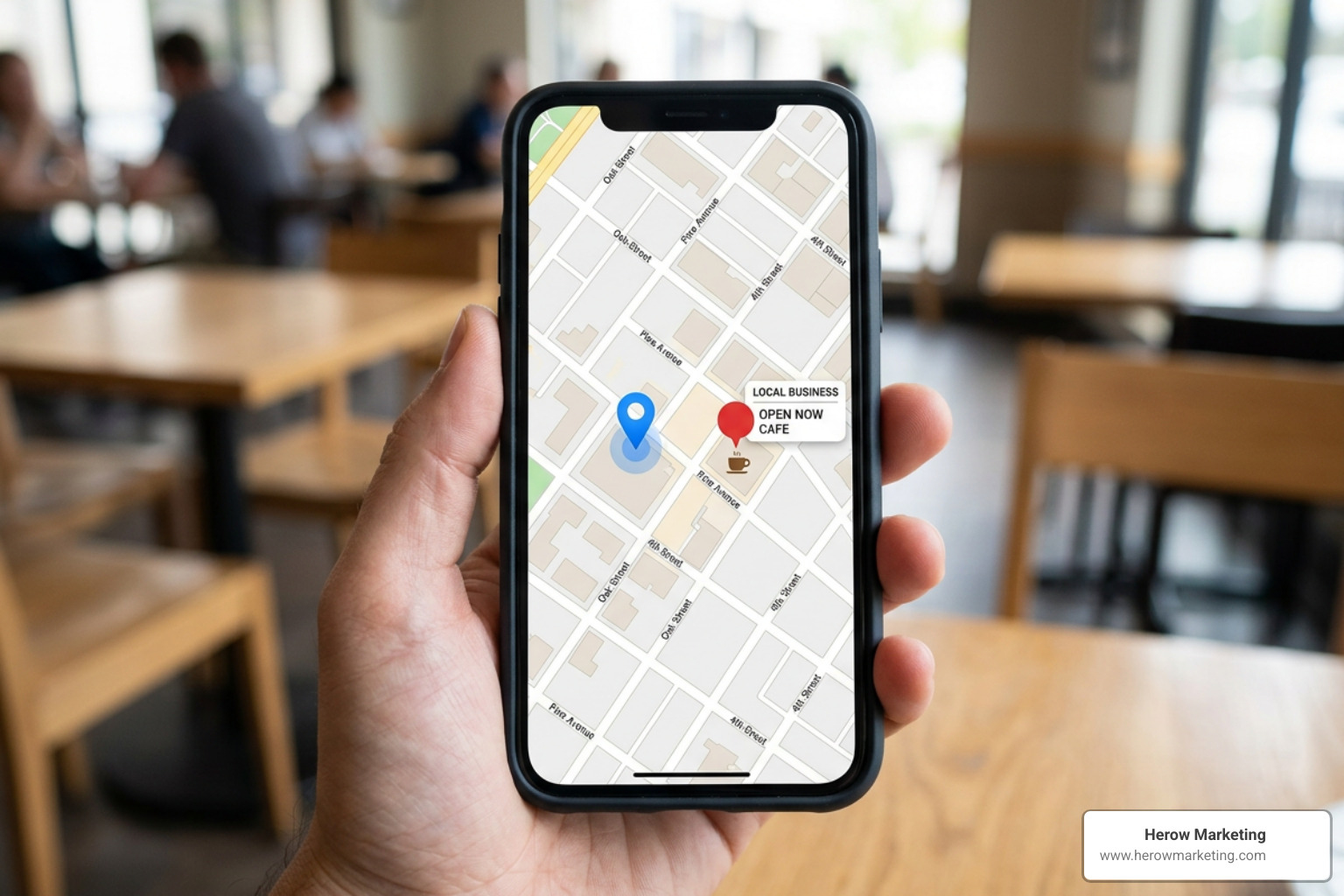
If your business relies on local customers, local search engine optimization is your most powerful long-term growth engine. In 2026, search engine optimization is no longer just about ranking for broad keywords on a desktop computer. It is about capturing immediate buyer intent on mobile devices and voice-activated search assistants.
With more than 70% of the world’s population using mobile internet, and “near me” searches with purchase intent continually climbing, local search visibility can make or break your business. Additionally, Google’s AI-driven search features mean that customers often get answers directly on the search results page. To survive in this “zero-click” era, your business must appear prominently in the local map pack and serve as a cited source for local answers.
For businesses operating in Bethlehem, PA, leveraging resources like the Small Business Resource Center at the Bethlehem Area Public Library can provide invaluable local data. To read about creative ways to stand out locally, check out Bold and Creative Marketing Strategies Small Business Edition.
Optimizing Your Google Business Profile and Online Reviews
Your Google Business Profile (GBP) is the absolute cornerstone of your local SEO strategy. When local customers search for your services, your GBP is often the very first thing they see.
To optimize your profile for maximum visibility and conversions, follow these key steps:
- Keep your NAP consistent: Ensure your Name, Address, and Phone number are identical across your website, social media, and local directories.
- Select precise categories: Choose the most accurate primary category for your business, and add relevant sub-categories.
- Add high-quality photos: Google’s own data shows that profiles with photos receive 42% more requests for directions. Update your photos regularly to show your team, your location, and your completed work.
- Manage reviews actively: Reviews are a primary ranking factor. Nearly 95% of people read reviews before making a purchase, and displaying reviews on your site can increase conversion rates by up to 270%.
A business with 200 four-star reviews will consistently outperform a competitor with only 10 five-star reviews because it demonstrates sustained, reliable customer satisfaction. Build a habit of asking every happy customer for a review within 48 hours of completing a job, and always respond to reviews—both positive and negative—with professionalism and speed.
Creating High-Value Content for the AI Search Era
Content marketing has changed fundamentally. The old playbook of writing generic, keyword-stuffed blog posts is officially dead. In 2026, the rise of Answer Engine Optimization (AEO) and Generative Engine Optimization (GEO) means search engines prioritize content that is direct, authoritative, and deeply helpful.
To make your content AI-friendly and attractive to human readers:
- Answer the question immediately: Place a clear, direct answer in the first two sentences of your article. AI search engines love to extract these snippets.
- Target intent-rich, long-tail queries: Instead of trying to rank for “plumber,” write content targeting “emergency pipe repair costs in Bethlehem.”
- Use clear formatting: Use structured bullet points, numbered lists, and FAQ schema markup so search crawlers can easily digest your pages.
- Prioritize real-world expertise: Share original images, case studies, and unique insights that AI tools cannot easily replicate.
By building a simple, repeatable content system, you establish your business as the ultimate local authority. For more ideas on how to craft content that commands attention, refer to Bold and Creative Marketing Strategies Small Business Edition and stay ahead of the curve with The 2026 Marketing Strategy Every Small Business Needs – Zyro Magazine .
Nurturing Leads with Email and Social Media
Attracting visitors to your website or social media profiles is only half the battle. To grow a sustainable business, you must have a reliable system to nurture those initial leads and turn them into repeat customers. This is where email marketing and social media engagement work hand-in-hand. While social media is fantastic for building initial trust and brand awareness, email marketing remains your most reliable, owned channel for driving direct conversions and maintaining customer loyalty.
Building an Automated Email Nurture System
Email marketing continues to hold the crown as the highest-return channel in digital marketing, boasting an average return of $36 for every $1 spent. Because email is permission-based, your subscribers have already raised their hands and expressed interest in what you do.
To build a high-converting email system from scratch, we recommend a simple three-step sequence:
- The Lead Magnet: Offer something of immediate value in exchange for an email address. This could be a “2026 Local Home Maintenance Checklist,” a free trial, or an exclusive discount.
- The Welcome Sequence: Deliver the lead magnet immediately, introduce your brand values, and share a customer success story. Keep these initial emails focused on providing value rather than pushing a hard sale.
- The Nurture-to-Conversion Flow: Send helpful, educational content once or twice a month, occasionally pairing it with a targeted promotion or seasonal offer.
Automation tools make it incredibly easy to set up these workflows so they run in the background while you focus on operations. For B2B businesses looking to master this lead generation process without overspending, we have compiled our best strategies in Mastering B2B Lead Generation Online Without Breaking the Bank.
Social Media Best Practices: Best Ways to Market Your Small Business with Limited Time
With 1 in 3 people globally using social media, these platforms offer an incredible opportunity for free organic reach. However, the biggest mistake small businesses make is trying to maintain a presence on every single platform at once. This quickly leads to burnout and low-quality, inconsistent content.
Instead, follow these highly efficient best practices:
- Master one or two platforms: Go where your target audience actually spends their time. If you run a local B2B service, focus on LinkedIn. If you run a visual, consumer-facing business like home remodeling or retail, focus on Instagram Reels or TikTok.
- Create a realistic content calendar: Commit to posting high-quality content three times a week rather than low-effort posts every day.
- Leverage User-Generated Content (UGC): Encourage your customers to share photos of your products or services, and repost their content (with permission). UGC builds massive trust because consumers trust peer reviews far more than traditional advertising.
- Repurpose everything: Turn one core monthly blog post into three social media captions, one short-form video, and one email newsletter update.
To build a social media presence that actually drives leads instead of just vanity metrics, explore A Comprehensive Guide to Social Media Marketing.
Paid Ads vs. Organic Strategies: Finding the Right Balance
To build a balanced marketing engine, you need to understand how paid and organic strategies complement each other. Paid advertising behaves like a faucet—you can turn it on for instant traffic, but it stops the moment you turn off the budget. Organic marketing is like planting a tree—it takes time to bear fruit, but once established, it provides shade and value for years to come.
| Marketing Metric / Feature | Paid Advertising (Google, Meta Ads) | Organic Marketing (SEO, Content, Email) |
|---|---|---|
| Time to Results | Very fast (1 to 7 days) | Medium to slow (3 to 6 months) |
| Upfront Cost | High (requires direct ad spend) | Low to medium (primarily time or content creation) |
| Long-Term ROI | Linear (stops when budget stops) | Compounding (grows in value over time) |
| Primary Benefit | Quick lead generation and precise targeting | High trust, authority, and zero ad-spend leads |
| Ownership | Rented space | Fully owned assets (email list, website authority) |
When to Deploy Paid Advertising for Quick Wins
If your small business is brand new or entering a highly competitive market, waiting three to six months for organic SEO to kick in might not be an option. This is when paid advertising becomes a highly strategic tool.
We recommend deploying paid ads under two specific scenarios:
- Capturing High-Intent Searchers: Google Ads are perfect for capturing prospects who are actively looking to buy right now. If someone searches “emergency AC repair Bethlehem PA,” they aren’t looking to read a blog post; they want to hire a professional immediately.
- Retargeting Warm Audiences: Use Meta Ads (Facebook and Instagram) to serve targeted ads to people who have already visited your website or joined your email list. Retargeting is incredibly cost-effective because you are only advertising to warm leads who are already familiar with your brand.
To avoid wasting your budget, never send ad traffic directly to your homepage. Instead, build a dedicated landing page with a single, clear call to action. To learn how to manage these paid campaigns like a seasoned professional, check out How to Manage Facebook Ads Like a Pro.
Leveraging Community Networking and Partnerships
Never underestimate the power of offline, local marketing. For small businesses, building deep relationships within your local community is often the absolute lowest-cost way to acquire high-value clients.
Consider setting up a structured referral program that offers direct incentives—such as discounts, loyalty points, or gift cards—to existing customers who introduce new clients to your business. Additionally, seek out partnerships with non-competing, complementary businesses. For example, a local wedding photographer can partner with florists, venues, and wedding planners to cross-promote services.
Sponsoring local events, joining the local chamber of commerce, or volunteering to speak at community workshops can also boost your brand recognition by up to 25%. These personal connections build a level of trust that digital ads simply cannot replicate.
Measuring ROI and Avoiding Common Marketing Mistakes
Many small business owners fall into the trap of measuring marketing success by “vanity metrics” like social media likes, followers, or page views. While these numbers look nice on a screen, they do not pay the bills. To make smart, data-driven decisions, we must focus on the metrics that directly impact your bottom line.
At Herow Marketing, we believe in complete transparency. That is why our strategic playbook includes delivering comprehensive, easy-to-understand monthly reports that tie every single marketing action directly to business growth. To see what a highly effective tracking system looks like, you can review The Best Marketing Report Samples for Every Campaign Type.
Tracking the Metrics That Actually Matter
To measure your true marketing ROI, focus your attention on these five core key performance indicators (KPIs):
- Conversion Rate: The percentage of website visitors who take a desired action (like filling out a contact form or making a purchase).
- Cost Per Lead (CPL): Total marketing spend divided by the number of leads generated.
- Customer Acquisition Cost (CAC): The total amount spent to acquire a single paying customer.
- Customer Lifetime Value (CLV): The total revenue a single customer brings to your business over their lifetime.
- Return on Ad Spend (ROAS): The revenue generated for every dollar spent on paid advertising.
Implementing a Customer Relationship Management (CRM) system is incredibly helpful for tracking these metrics. In the United States, about half of small and midsize businesses currently use a CRM system to manage customer journeys and measure sales performance. For legal compliance and structured tracking advice, refer to the SBA’s guidelines on Marketing and sales | U.S. Small Business Administration .
Avoiding the Multi-Channel Overload Trap
The single biggest mistake we see small businesses make is multi-channel overload. It is far better to run one or two marketing channels exceptionally well than to run five channels poorly.
When you try to post on TikTok, write blog posts, send weekly emails, run Google Ads, and attend three networking mixers a week, your quality drops, your consistency slips, and your budget gets stretched too thin.
To avoid this, pick your primary acquisition channel (e.g., local SEO) and master it. Once that channel is running smoothly and generating consistent revenue, you can safely reinvest those profits into amplifying your reach with paid ads or exploring a secondary platform.
Frequently Asked Questions about Small Business Marketing
How long does it take to see results from SEO?
Generally, you can expect to see initial Google Business Profile improvements within 2 to 4 weeks. However, a deeper, comprehensive search engine optimization and content marketing strategy typically takes 3 to 6 months to show meaningful, compounding results. While it requires patience, the long-term ROI is unmatched because organic traffic continues to flow without ongoing ad costs.
When should a small business hire an agency versus handling marketing DIY?
If you are in the pre-revenue or early startup phase, handling your marketing DIY is often the smartest choice to preserve cash flow. However, as your business grows, your time becomes your most valuable asset. If you find yourself spending 10+ hours a week struggling with marketing tasks—time that could be spent billing clients or improving your operations—it is time to bring in professional help.
A hybrid model (handling simple social media in-house while outsourcing technical SEO and paid ads) is often a fantastic middle ground. To find the right partner and avoid common pitfalls, read our guide on how to Don’t Get Burned: The Best Digital Marketing Agencies for Small Business or explore The Best Small Advertising Agencies for Your Growing Business.
What tools offer the best value for a small business marketing budget?
You do not need a massive enterprise software budget to market like a pro. For email marketing and automation, platforms like Mailchimp or Constant Contact offer incredibly cost-effective starter plans. For social media scheduling, tools like Buffer or Later can save you hours of manual posting. For design, Canva makes it easy to create beautiful, professional-grade graphics and business cards on a shoestring budget. Finally, always make sure to set up Google Analytics—a completely free tool that is essential for tracking website traffic and conversions.
Conclusion
Successfully marketing your small business does not require a massive corporation’s budget. It requires a clear, focused strategy, consistent execution, and the right partner to help you navigate the ever-changing digital landscape.
At Herow Marketing, based right here in Bethlehem, PA, we help small businesses cut through the noise. Our time-tested strategic playbook and commitment to full transparency via monthly data reports ensure that every dollar you invest drives real, measurable growth.
Ready to build a marketing system that works for you around the clock? Explore Our Digital Marketing Services today, and let’s start turning your marketing efforts into your business’s strongest compounding asset.