


The Ultimate Content Marketing Guide for Small Businesses
The Ultimate Content Marketing Guide for Small Businesses
Why Content Marketing for Small Businesses Changes Everything
Content marketing for small businesses is the practice of creating helpful, relevant content — blog posts, videos, emails, social posts — that attracts your ideal customers, builds trust, and drives sales over time.
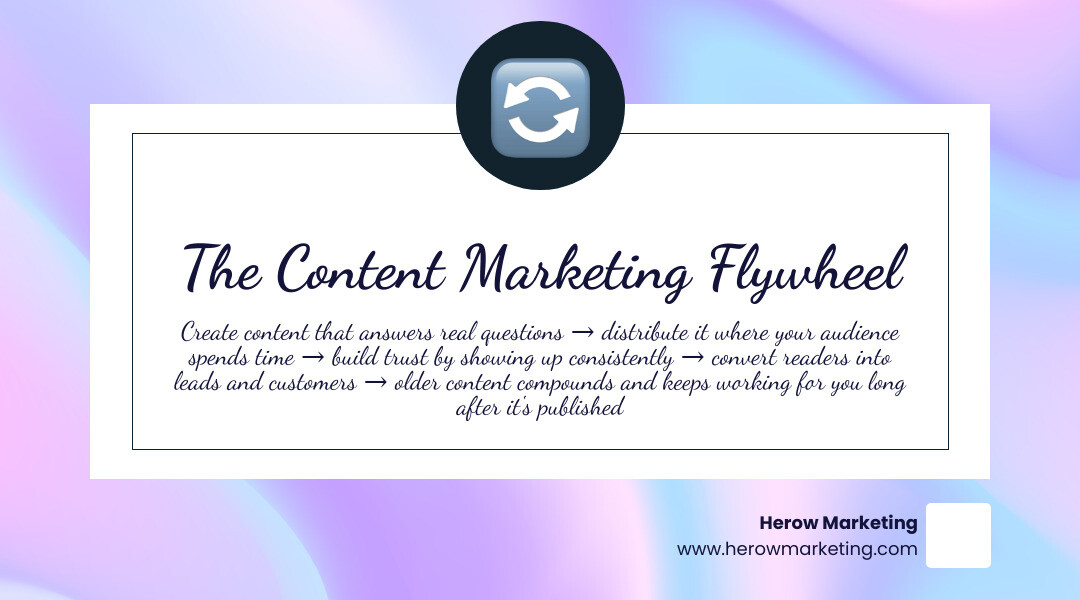
Here’s the quick version of how it works:
- Create content that answers real questions your customers are already asking
- Distribute it where your audience spends time (search, email, social)
- Build trust by consistently showing up with useful information
- Convert readers into leads and customers through clear calls to action
- Compound — older content keeps working for you long after it’s published
Unlike paid ads that stop the moment your budget runs out, content marketing builds an asset. Every article, video, or email you publish continues to attract new customers for months — sometimes years.
The numbers back this up. Only 57% of small businesses are doing any content marketing at all, yet 44% of those who do say their top goal is generating new customers. That gap is your opportunity.
Still, most small business owners find it overwhelming. You’re already managing operations, staff, and sales — and now you’re supposed to run a blog too?
That’s exactly what this guide is for.
I’m Gianna Heron, founder of Herow Marketing — I’ve spent years combining creative direction, business strategy, and data-driven digital marketing to help small businesses grow their online presence, and content marketing for small businesses is one of the highest-leverage tools in that playbook. This guide walks you through everything, step by step, so you can build a strategy that actually works without wasting time or money.
Content marketing for small businesses terms you need:
- small business marketing
- best ways to market your small business
- creative marketing strategies for small business
What is content marketing for small businesses?
To truly understand content marketing for small businesses, it helps to contrast it with traditional advertising.
Traditional advertising is about interruption. It stops people from doing what they actually want to do—like watching a video or reading an article—to say, “Hey! Look at me! Buy this right now!” This linear approach can be incredibly expensive, and the moment you stop paying for those ad spots, your traffic and leads vanish into thin air.
Content marketing, on the other hand, is about earning attention. Instead of interrupting, you provide the exact information your prospective customers are searching for. It is conversational, educational, and helpful. You are explaining options, addressing hesitations, and building long-term brand authority. When you create high-quality content, you build an ongoing digital asset that keeps working for your business 24/7.
For small businesses, this approach is a complete game-changer. It levels the playing field against massive competitors. While a large corporation might have a multi-million dollar ad budget, they often struggle to replicate authentic, localized, and intimate storytelling. As a small business, you can speak directly to your local community’s unique needs, establishing deep trust and showing genuine expertise.
To discover more about building a cohesive online footprint, check out our guide on Digital Growth Best Ways To Market A Small Business Online.
Building a High-Impact Content Strategy on a Budget
Many small business leaders feel a competitive disadvantage when meeting customer expectations compared to massive enterprises. However, you do not need a massive corporate budget to succeed. In fact, most small businesses invest around 5% to 10% of their revenue in digital marketing, and content marketing delivers a highly cost-effective return on that investment because its value compounds over time.
To build a high-impact strategy on a lean budget, we must move away from random, uncoordinated posting and adopt a structured, commercial-first framework.
The 70/30 Content Rule
A common mistake is spending 100% of your time writing generic, high-level informational articles. Instead, we recommend the 70/30 rule:
- 70% Commercial Content: Focus on bottom-of-the-funnel (BOFU) and middle-of-the-funnel (MOFU) content. This includes core service page optimization, comparison guides, transparent pricing breakdowns, and localized case studies. This is the content that directly drives leads and sales.
- 30% Authority-Building Content: Focus on top-of-the-funnel (TOFU) educational content that answers broad questions, addresses common industry misconceptions, and builds brand awareness.
The Topic Cluster Model
Rather than writing disconnected blog posts, organize your content into “topic clusters.” This is highly favored by search engines like Google in 2026.
- Pillar Page: Create one comprehensive, in-depth guide on a core service or product (e.g., “The Complete Guide to Home Heating Systems in Eastern Pennsylvania”).
- Cluster Content: Write 8 to 10 shorter, highly specific articles addressing related subtopics (e.g., “How to Prepare Your Furnace for Winter,” “Signs Your Heat Pump Needs Repair,” or “Comparing Gas vs. Electric Heating Costs”).
- Internal Linking: Link all cluster articles back to the main pillar page and to each other. This builds powerful topical authority and tells search engines exactly what your website is about.
Building Your Content Calendar
Consistency is always superior to high volume. Staring at a blank page on a Tuesday night trying to figure out what to publish is a recipe for burnout. Instead, block 2 to 3 hours once a week to batch your content creation, and organize your ideas into a simple calendar.
For a solo operator, a realistic cadence is 2 high-quality, commercially-focused posts per month. If you have a small marketing team, aim for 4 to 8 posts per month.
To help you decide how to allocate your resources, review this comparison of content execution paths:
| Content Approach | Best For | Pros | Cons |
|---|---|---|---|
| DIY (Do-It-Yourself) | Solo founders, very tight budgets, businesses requiring highly personal brand voices. | 100% free; ensures complete authenticity and deep domain expertise. | Extremely time-consuming; requires learning SEO and writing basics. |
| Freelancers | Growing businesses needing regular content production without full-time overhead. | Cost-effective; flexible scaling; access to professional writing skills. | Requires time to manage, edit, and align with your brand voice. |
| Digital Agency | Established SMBs looking for strategic growth, scale, and complete hands-off execution. | Full strategy, professional SEO optimization, consistent scheduling, and detailed reporting. | Requires a larger monthly budget; requires finding the right strategic partner. |
For more budget-friendly promotion tactics, explore our resource on Penny Pinching Promotion Cheap Ways To Market Your Business. For a deeper dive into scaling your strategy professionally, you can read about the framework in HubSpot’s Ultimate Guide to Content Marketing.
Defining Your Target Audience and Content Pillars
Before you write a single word, you must know exactly who you are writing for. If you try to speak to “everybody,” you end up connecting with nobody.
To define your target audience, conduct a simple 20-minute exercise to map out your primary customer types. Answer these key questions:
- What is their primary goal or problem?
- What makes them hesitate or feel skeptical about your industry?
- What are they searching for on Google at 10 p.m. when their problem is urgent?
- What are the real-world consequences if they do not solve this problem?
Once you understand their pain points, structure your content into 3 to 5 core “content pillars.” For example, a local Bethlehem, PA bakery might focus its pillars on:
- Generational recipes and local ingredient sourcing (building trust and quality).
- Behind-the-scenes family baking processes (humanizing the brand).
- Event catering and custom cake planning tips (driving high-value commercial leads).
Storytelling: The Founder’s Story vs. The Brand Story
Small businesses have a distinct competitive edge in storytelling. In the early stages of your business, lean heavily into your founder’s story. Why did you start this business? What gap did you see in your local community? This human-centric story acts as a powerful hook that invites customers to buy into you before they buy your products.
As your business grows, you can naturally transition to highlighting your brand story—focusing on customer success stories, community involvement, and your team’s collective values. By utilizing frameworks like the StoryBrand model, you position your customer as the “hero” of the journey, and your business as the trusted “guide” helping them succeed.
Choosing the Best Content Formats for Your Audience
Not every business needs to be on every platform. A local plumber does not need a podcast, and a niche business consultant shouldn’t bet their entire budget on viral TikTok dances. Choose formats that match both your audience’s habits and your team’s creative strengths.
- SEO Blogs and Articles: Blogging remains a cornerstone of content marketing. In fact, 47% of B2C marketers say short articles and blog posts delivered the best results for their content marketing. Blogs are highly effective because they capture active search intent and are increasingly cited by large language models (LLMs) in AI search engines.
- Authentic Video Content: Video is highly engaging, but do not feel pressured to produce Hollywood-level productions. Audiences in 2026 value raw, authentic, behind-the-scenes video over highly polished corporate ads. Use your smartphone to record quick product demonstrations, meet-the-team clips, or simple educational tips.
- Podcasts and Audio: Podcasting is an incredibly intimate medium with low production costs. It is highly accessible because you can record and distribute episodes directly from a smartphone, making it a fantastic format for targeting highly specific, niche audiences.
- Webinars and Live Q&As: Hosting live webinars addressing hot topics or common customer pain points is an exceptional way to build real-time trust, showcase your deep expertise, and capture high-quality leads.
To discover the best digital tools to help bring these formats to life, read our breakdown of the Top Content Creation Websites To Make Your Site Pop.
Maximizing Reach: Distribution and Content Repurposing
Creating great content is only half the battle. If nobody sees it, your hard work goes to waste. A good rule of thumb is to spend 50% of your effort on content creation and the other 50% on distribution and promotion.
To maximize your efficiency, we advocate for the 1:7 Repurposing Rule. Instead of constantly chasing new content ideas, pick one high-quality, long-form anchor piece (like a comprehensive blog post or a podcast episode) and systematically break it down into multiple smaller assets.
Using this workflow, a single blog post can easily become:
- An engaging email newsletter sent to your subscriber list.
- A detailed text-based post on LinkedIn sharing key takeaways.
- A visually appealing carousel graphic on Instagram.
- A quick, 60-second vertical video explaining a single tip.
- A thread on Twitter/X summarizing the main concepts.
- An updated FAQ section on your core service page.
- A helpful, direct response to a community question on Reddit or local forums.
This approach ensures you are consistently showing up across multiple channels without burning out. To learn more about tailoring your message for different platforms, check out A Comprehensive Guide To Social Media Marketing. For a deeper exploration of building an efficient small-team marketing framework, see this guide on developing a content strategy.
Integrating Email Marketing into Your Content Strategy
While social media algorithms change constantly and organic search rankings can fluctuate, your email list is a marketing channel that you fully own. It provides a direct, personalized, and highly reliable connection to your audience.
The key to building a high-value email list is offering an irresistible lead magnet—a free, high-value resource given in exchange for a prospect’s email address. Once they sign up, do not immediately hit them with a hard sales pitch. Instead, trigger an automated email sequence of 3 to 5 emails that delivers value, introduces your brand personality, and gently guides them toward a paid offer.
High-Converting Lead Magnet Ideas for Small Businesses:
- Actionable Checklists: A simple, one-page PDF checklist (e.g., “The Ultimate Moving Checklist for New Homeowners”).
- Step-by-Step How-To Guides: A short, highly focused guide solving a specific problem (e.g., “How to Fix Common Lawn Care Mistakes”).
- Interactive Calculators or Templates: A downloadable spreadsheet or interactive tool (e.g., “The Small Business Budget Planner”).
- Exclusive Discounts or Offers: A special introductory discount code for first-time subscribers.
Remember to segment your email list based on subscriber interests and behaviors, ensuring every newsletter you send feels highly relevant and personalized.
Key Metrics to Track Content Marketing for Small Businesses
To ensure your efforts are driving actual business growth rather than just generating “likes,” you must track the metrics that actually matter. Vanity metrics (like page views, social impressions, and follower counts) feel good, but they do not pay rent.
Instead, focus on tracking clear business-focused Key Performance Indicators (KPIs):
- Organic Search Clicks & Impressions: Tracked via Google Search Console to monitor your growing visibility on search engines.
- Lead Generation Metrics: The number of form submissions, phone calls, consultation bookings, or chat initiations directly attributed to your content pages.
- Email List Growth: Your monthly rate of new email subscribers and email engagement rates (open and click-through rates).
- Conversion Rate: The percentage of website visitors who take a desired action (e.g., a 2% to 5% page-to-lead conversion rate is a healthy target for mature content pages).
- Customer Acquisition Cost (CAC): How much you spend on content creation and distribution divided by the number of new customers acquired. Over time, content marketing’s compounding effect should steadily drive your CAC down.
Set up a simple tracking dashboard using tools like Google Analytics 4 (GA4) and review these metrics once a month to make data-driven adjustments to your strategy.
Common Pitfalls in Content Marketing for Small Businesses
To keep your content marketing engine running smoothly, avoid these common traps:
- Giving Up Too Early: Content marketing is a long-term investment. Many business owners publish three blog posts, see no immediate sales, and conclude it doesn’t work. Organic growth requires a consistent runway of at least 3 to 6 months before showing visible acceleration.
- Writing for Yourself: Your content must be entirely customer-centric. Avoid writing self-serving posts about internal company news or industry jargon. Instead, write about the exact problems, questions, and hesitations your customers face.
- The Perfectionism Trap: A published post that is 80% perfect and offers real value is infinitely better than a “perfect” 95% draft that sits in your folder forever. Embrace an agile mindset: ship your content, gather feedback, and iterate over time.
- Relying on Generic AI Content: Search engines and readers are incredibly sophisticated at spotting generic, unedited AI-generated text. If your content lacks original insights, personal anecdotes, or real-world experience, it will struggle to rank or build trust.
To read a realistic, practical take on avoiding these roadblocks, explore the Content Marketing Institute’s resources.
Frequently Asked Questions about Small Business Content Marketing
How long does it take to see results from content marketing?
Content marketing is a compounding asset, meaning progress builds over time. Here is a realistic timeline of what to expect with consistent execution:
- Months 1–2: Almost zero organic traffic. This phase is about establishing your keyword strategy, optimizing service pages, and publishing your first core cluster articles.
- Months 3–4: Early signs of life. You will begin to see a steady rise in search impressions and minor organic traffic (typically 10 to 50 visitors per month) as search engines index your content.
- Months 5–6: Compounding acceleration. Organic traffic often scales to 100–300+ visitors per month, and you will begin to see consistent, trackable inbound leads and email signups.
- Months 7–12 & Beyond: Mature compounding. Your older articles continue to attract hundreds of targeted visitors every month without additional spend, creating a highly cost-effective customer acquisition channel.
Should small businesses use AI to write content?
Generative AI tools are incredible assets when used correctly. You should treat AI as a drafting accelerator and brainstorming assistant, not a replacement for human expertise.
Google’s search guidelines strictly reward high-quality content that demonstrates real-world experience, expertise, authoritativeness, and trustworthiness (E-E-A-T). AI cannot interview your customers, share localized Bethlehem community anecdotes, or provide original industry observations. Use AI to build outlines or speed up initial drafts, but always heavily edit the output to inject your unique voice, real-world case studies, and genuine expertise.
How much should a small business spend on content marketing?
A typical digital marketing budget for small businesses ranges from 5% to 10% of overall revenue. For a dedicated, professional content marketing campaign that drives measurable organic growth within 4 to 6 months, a realistic budget typically ranges from $2,000 to $5,000 per month.
If your budget is currently below $1,500 per month, we highly recommend focusing your resources on optimizing your core service pages and local SEO first before investing heavily in broad informational blogging.
Conclusion
Building a successful online presence does not require the massive budget of a global enterprise. By focusing on a commercial-first content strategy, organizing your ideas into topic clusters, and consistently repurposing your best work, you can outcompete larger brands and build deep, lasting trust with your ideal local customers.
At Herow Marketing, we specialize in helping small businesses navigate this journey. Based in Bethlehem, PA, we combine branding, social media, web development, SEO, and professional media production into a time-tested, strategic playbook. We believe in complete transparency, providing our clients with detailed monthly data reports that show exactly how our efforts are driving measurable growth and real-world leads for their businesses.
Ready to stop guessing and start growing your digital footprint? Explore Our Services today, or learn more about finding the right strategic partner in our review of The Best Small Digital Agencies For 2025. Let’s build a content engine that works for your business 24/7.