

How to Handle a Social Media Crisis Without Crying
When One Post Can Burn Down Everything You’ve Built
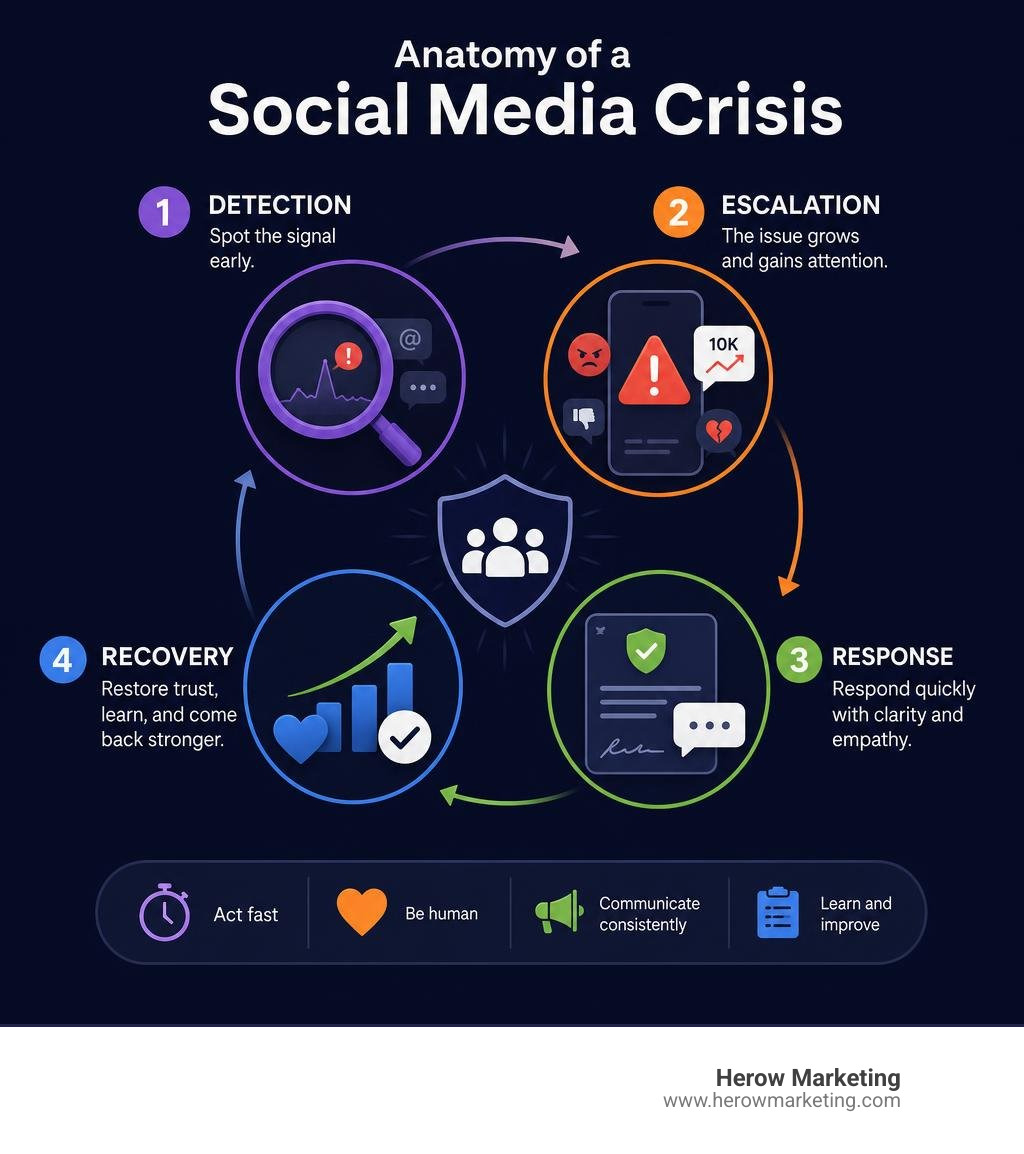
Crisis management on social media is the process of identifying, responding to, and recovering from events that threaten your brand’s reputation online — before they spiral out of control.
Here’s the short version of how to handle it:
- Detect the issue early using social listening tools
- Pause all scheduled content immediately
- Acknowledge the situation publicly within 30–60 minutes
- Respond with a clear, empathetic, fact-based statement
- Update your audience consistently until the crisis is resolved
- Review what happened and update your playbook afterward
One viral post. One misread comment. One tone-deaf caption at the wrong moment.
That’s all it takes.
And it doesn’t matter how small your business is. Any brand with a social media presence can find itself on the wrong end of public outrage — fast. According to research, 78% of consumers say a brand’s social media presence directly affects whether they trust it. For Gen Z, that number jumps to 88%.
The difference between a brand that survives and one that doesn’t usually comes down to one thing: preparation.
Most small business owners don’t have a crisis plan. When something goes wrong, they freeze — or worse, they respond defensively and make it worse.
This guide will walk you through exactly what to do, step by step.
I’m Gianna Heron, founder of Herow Marketing — my background spans performance, finance, brand strategy, and creative direction, all of which inform how I approach crisis management on social media with both strategic clarity and human instincts. If you’re a small business owner who’s ever panicked over a negative comment going sideways, you’re in the right place.
Related content about crisis management social media:
Understanding Crisis Management Social Media in 2026
As we navigate June 2026, the digital landscape is more interconnected than ever. With approximately 73% of adults in the United States actively using social platforms, social networks have evolved from simple communication channels into primary news hubs. In fact, 55% of frequent Twitter (now X) users and 47% of frequent Facebook users regularly use these platforms to view and digest the news.
For businesses here in Bethlehem, PA, and across the globe, this means that your social media presence is no longer just a digital billboard. It is the living, breathing front door of your brand. When stakeholders, customers, or local community members seek answers, accountability, or real-time updates during a challenging situation, they look to social media first.

Because of this constant digital connectivity, the stakes for maintaining brand trust have never been higher. A single misstep can compromise years of reputation building in a matter of clicks. Understanding how to manage this dynamic is the first step in our Comprehensive Guide to Social Media Marketing, which lays the foundation for building a resilient online presence.
How Crises Emerge and Escalate Online
A social media crisis rarely behaves like a traditional public relations issue. In the past, a company had hours, if not days, to draft a press release and coordinate with journalists. Today, a crisis breaks in real-time, often bypassing traditional media entirely before peaking.
Crises typically emerge in one of two ways:
- Internal Triggers: An employee posts an offensive comment, a scheduled marketing campaign goes live during a national tragedy, or a product defect leads to a sudden surge of customer complaints.
- External Triggers: A customer complaint goes viral, a competitor launches a smear campaign, or a broader industry-wide issue drags your brand into the spotlight.
Once a spark is lit, platform algorithms act as accelerants. Algorithms are designed to prioritize high-engagement content, and unfortunately, outrage is one of the most potent drivers of online engagement. A single negative post can be amplified to thousands of feeds within hours. Compounding this issue is the rapid spread of misinformation. Without immediate, factual intervention, speculation quickly fills the information void.
In some cases, the sheer speed of social media can make small issues look like catastrophes. For a deep dive into how platforms alter communication dynamics during critical moments, read Some Thoughts on Using Social Media in a Crisis.
Common Challenges in Digital Crisis Response
When the notifications start piling up, even seasoned marketing teams can experience panic. Some of the most common hurdles organizations face include:
- Information Validation vs. Speed: The pressure to respond instantly is immense, but releasing unverified or incorrect details can destroy credibility. Teams must find a way to validate facts while keeping the public informed.
- Outdated Recirculation: Because of the non-chronological nature of modern feeds, old updates can recirculate weeks after an issue is resolved, confusing users and restarting the outrage cycle.
- Staff Burnout: Managing a digital onslaught is emotionally taxing. Social media managers are on the front lines, absorbing negative comments and working around the clock, which quickly leads to fatigue and mistakes.
To navigate these challenges successfully, organizations must look at established frameworks used by high-stakes public agencies. For example, the emergency response protocols detailed in the Best Practices in Social Media Crisis Communications offer invaluable lessons on structured coordination, ensuring that even small teams can manage intense online pressure without breaking.
Proactive Preparation: Building Your Crisis Playbook
If you wait until a crisis hits to figure out who owns your social logins, who drafts the copy, and who signs off on the messaging, you have already lost. Effective crisis management social media relies entirely on having a documented, rehearsed playbook ready to deploy at a moment’s notice.

A solid playbook isn’t a dusty, 50-page PDF that lives on an unreachable shared drive. It is a dynamic, actionable resource that outlines clear responsibilities. One of the best ways to structure this is by using a RACI matrix (Responsible, Accountable, Consulted, Informed) to define roles:
- The Decider (Accountable): Usually the CMO, PR lead, or business owner. They have the final sign-off on all public statements.
- The Drafter (Responsible): The copywriter or communications specialist who crafts the responses.
- The Publisher (Responsible): The social media manager who physically posts the updates and manages the accounts.
- The Monitor (Responsible/Consulted): The team member tracking sentiment, volume, and mentions.
This level of operational readiness is a core pillar of any sustainable growth strategy, as detailed in The Complete Guide to Small Business Marketing.
Best Practices for Crisis Management Social Media
When building your playbook, there are several foundational best practices you must integrate to ensure rapid, orderly execution:
- Develop a Cache of Pre-Approved Holding Statements: You won’t know the exact details of a future crisis, but you can anticipate the categories (e.g., service outages, product recalls, customer service disputes). Write and pre-approve templates that acknowledge the situation, state that you are actively investigating, and promise a specific timeline for the next update.
- Establish Content Pausing Protocols: There is nothing worse than a cheerful, pre-scheduled promotional tweet going live while your brand is actively apologizing for a major mistake. Your playbook must include a “kill switch” protocol to instantly pause all automated posts, scheduled campaigns, and active digital ads.
- Define Severity Tiers: Not every negative comment is a crisis. Establish a clear classification system (e.g., Tier 1: Low-level customer complaint; Tier 2: Moderately high negative sentiment; Tier 3: Existential brand threat). This prevents your team from overreacting to minor issues while ensuring major threats get immediate executive attention.
For a step-by-step breakdown of how to build and maintain these operational layers, consult the Crisis Communication Plan Guide.
Coordinating Messaging Across Teams and Partners
During a high-stress event, internal confusion is your greatest enemy. If your customer service team is telling customers one thing on the phone, your PR agency is saying another to local reporters, and your social media manager is posting something entirely different on X, your credibility will collapse.
To prevent this, establish a centralized “Command Center” (even a virtual one via a dedicated Slack channel or Microsoft Teams space) where all key stakeholders can align. If you work with external agencies, ensure their contracts explicitly state their response-time commitments and define who has creative authority versus who has legal sign-off.
Every public post, internal email, and partner update must stem from a single source of truth. As emphasized in the Executive Guide to Real-Time Response, keeping your message clear, consistent, and completely free of defensive corporate jargon is the only way to retain control of the narrative.
The Dual Role of AI in Modern Crises
In 2026, artificial intelligence is a double-edged sword. On one hand, deepfakes, AI-generated misinformation, and coordinated bot networks can manufacture or accelerate a brand crisis in minutes. On the other hand, AI-driven tools are the most powerful weapons we have to detect and mitigate these threats before they cause permanent damage.
To stay ahead of modern threats, your marketing tech stack must include tools that do more than just schedule posts. You need a unified system that monitors the digital landscape 24/7. To see how these tools fit into your daily marketing operations, explore our breakdown of the One Dashboard to Rule Them All: Top Social Media Tools.
The Role of AI in Crisis Management Social Media
When applied strategically, AI acts as an early warning system and operational support tool. Key applications include:
- AI-Powered Social Listening: Traditional keyword monitoring only alerts you when someone tags your brand. AI-powered listening tools analyze broader conversation patterns, tracking sudden spikes in mention volume or sharp drops in sentiment. This allows you to catch a rising issue hours before it starts trending.
- Bot and Spam Filtering: Coordinated, bot-amplified outrage is a growing challenge. AI filters can analyze account diversity, duplicate phrasing patterns, and engagement shapes to help you distinguish between genuine consumer backlash and manufactured, bot-driven noise.
- Predictive Modeling and Sentiment Analysis: Advanced sentiment tools can connect real-time conversations with your historical brand baseline, predicting how a specific issue might impact your reputation over time.
By utilizing these advanced technologies, organizations can move from reactive damage control to proactive reputation defense. For a comprehensive look at how digital listening reshapes modern PR, read the academic study on Using Social Media Listening in Crisis Communication.
The Response Phase: Balancing Speed, Transparency, and Empathy
When a crisis occurs, your first response sets the tone for everything that follows. The golden rule of modern digital PR is simple: the first response should ideally go out within 30 to 60 minutes of identifying the issue.
This initial message is rarely a complete solution. Instead, it is a holding statement. It tells your audience: “We see you, we know there is a problem, we are investigating, and we will update you here in one hour.” This simple step immediately de-escalates tension and stops people from assuming you are ignoring the issue.
To guide your response strategy, compare these two common approaches:
| Defensive / Slow Response (What NOT to do) | Empathetic / Transparent Response (What to do) |
|---|---|
| Deleting negative comments or turning off replies | Keeping comment sections open and actively monitoring |
| Waiting 24+ hours to gather “all the facts” | Acknowledging the issue within 60 minutes |
| Blaming third-party vendors or shifting responsibility | Owning the mistake and taking immediate accountability |
| Using complex, corporate legalese | Communicating in plain, human language |
| Going completely silent on all channels | Pausing promotions while keeping updates focused on the issue |
When drafting your official response, focus on the “Three Cs” of crisis communication:
- Care: Show genuine empathy for those affected.
- Clarity: State the facts clearly without using spin or jargon.
- Commitment: Outline the concrete steps you are taking to fix the issue and prevent it from happening again.
For practical guidelines on maintaining this balance across different digital platforms, see the Tips for Using Social Media in Crisis Management.
Post-Crisis Recovery and Rebuilding Brand Trust
Once the immediate wave of negative attention recedes, the real work begins. Rebuilding brand trust is a long-term process that requires consistent, transparent action. According to industry data, 65% of consumers remain loyal to brands that respond transparently during a crisis. People are incredibly forgiving of organizational mistakes, provided that leadership addresses the issue directly and follows through on their promises.
The recovery phase should always begin with a formal post-mortem review within 14 days of the incident:
- Reconstruct the timeline of the crisis from the first post to the final resolution.
- Audit all outbound messages to see what resonated and what fell flat.
- Identify any gaps or delays in your decision-making process.
- Update your crisis playbook, templates, and team contact sheets based on your findings.
Once your internal processes are updated, focus on external recovery. Launch targeted, value-driven campaigns that highlight your corrective actions. If you promised to update a policy, upgrade your systems, or support a local cause, use your social channels to show your progress.
For a deeper academic and practical look at how brands rebuild their digital authority after a major reputational hit, explore the resources provided by the Social Media Crisis Communication and Management program.
Measuring the Effectiveness of Your Crisis Response
You cannot manage what you do not measure. To understand how well your team handled a crisis—and to prove the value of your crisis preparation to leadership—you must track specific metrics:
- Response Time: How long did it take to identify the threat? How quickly did your first holding statement go live?
- Sentiment Shift: Track the ratio of positive, neutral, and negative mentions over time. Look for the point where negative sentiment began to level off and decay.
- Share of Voice (SOV): Measure how much of the online conversation about your brand was dominated by the crisis versus your normal business topics.
- Inbound Message Volume: Monitor the volume of customer service tickets and direct messages to ensure your team is meeting response-time baselines.
Tracking these metrics requires clean data and highly organized digital campaigns. If you are running active paid acquisition strategies alongside your organic recovery efforts, make sure you know How to Manage Facebook Ads Like a Pro to avoid cross-contaminating your data and wasting ad spend during a sensitive period.
Frequently Asked Questions about Crisis Management
How quickly should a brand respond to a social media crisis?
Ideally, your brand should issue an initial acknowledgment or holding statement within 30 to 60 minutes of identifying a Tier 3 crisis. You do not need to have all the answers or a finalized solution to post. Simply acknowledging the situation, stating that you are investigating, and committing to a specific time for the next update is enough to show responsiveness and buy your team time to gather verified facts.
Should we delete negative comments during a social media crisis?
Generally, no. Deleting negative comments or customer complaints is highly counterproductive. Screenshots are easy to take, and deleting comments signals defensiveness and a lack of accountability, which usually outrages users more than the original issue. The only exceptions are comments that directly violate platform community guidelines by containing hate speech, personal threats, spam, or explicit language. Instead, respond constructively, provide facts, and offer to take highly specific or personal customer service issues to a private channel (like DM or email).
How do you tell a real crisis from manufactured outrage?
To separate a genuine reputational threat from bot-amplified noise or minor complaints, look at three key indicators:
- Account Diversity: Are the negative comments coming from a wide range of established, human-tier profiles, or are they clustered around newly created accounts with no followers?
- Phrasing Patterns: Real crises feature diverse, human voices expressing unique concerns. Manufactured outrage often relies on duplicate, copy-pasted phrasing across multiple accounts.
- Engagement Shape: A real crisis typically shows a sustained, multi-day upward trend in mentions and shares across multiple platforms, whereas manufactured outrage often spikes sharply and disappears within 24 to 48 hours when the bot network moves on.
Conclusion
At the end of the day, handling a social media crisis without crying comes down to having a plan, staying calm, and treating your audience like human beings. There is no magic algorithm that can erase a mistake, but transparency, speed, and genuine empathy will protect your brand’s reputation far better than any corporate spin ever could.
At Herow Marketing, we believe that your digital presence should be built on a foundation of resilience. Our time-tested strategic playbook combines creative brand direction with absolute data transparency, giving you the tools to grow safely and measurably. Whether you need to audit your current social setups, build a bulletproof crisis response plan, or completely revitalize your digital presence, we are here to help.
Don’t wait for a crisis to find out if your playbook works. Protect Your Brand with Herow Marketing and let’s build a digital strategy that stands strong, no matter what the internet throws your way.